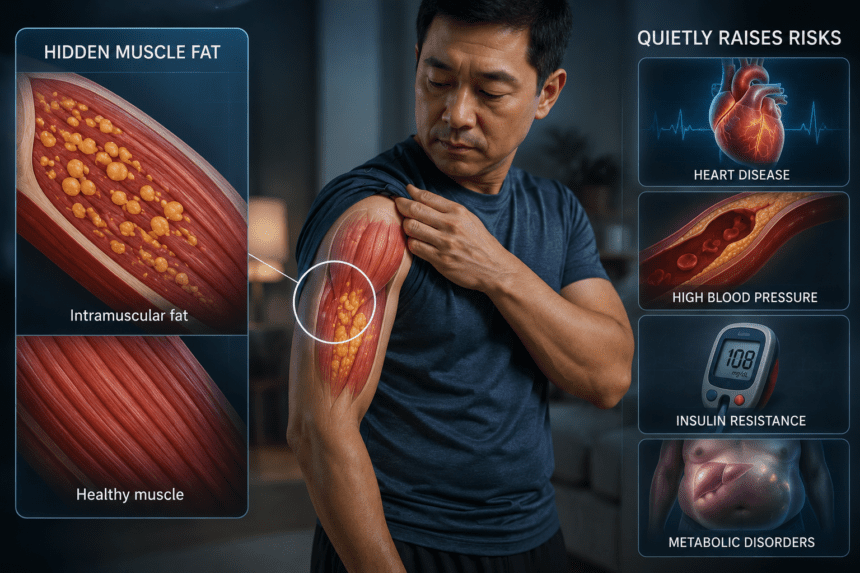
Doctors have long tracked visceral fat around the organs, but a new study suggests the fat hiding inside your muscles intramuscular adipose tissue is an equally dangerous indicator of long-term health. Researchers found that this “hidden” fat doesn’t just sit idle. It actively interferes with how muscles process glucose and fats, creating a ripple effect that destabilizes metabolic health.
While traditional BMI often misses these deeper structural changes, the presence of fat within the muscle tissue acts as a quiet, persistent driver of insulin resistance and cardiovascular strain. The risk isn’t limited to individuals with high body weight.
Even those within a “normal” weight range can harbor significant intramuscular fat, a condition sometimes referred to as “skinny fat” or metabolically obese normal weight. When muscle fiber is infiltrated by fat cells, the muscle loses its efficiency as a metabolic engine. It stops burning energy effectively, leading to higher blood sugar levels and increased systemic inflammation.
Dr. Elena Rossi, a metabolic health specialist not involved in the study, points out that we’ve been looking at the wrong measurements for too long. “We’ve relied on the scale as our primary health metric, but the scale is blind to body composition,” she says. “Muscle quality matters as much as muscle quantity. When muscle is replaced by fat, the body’s ability to manage stress and energy crashes.
” The study highlights that sedentary behavior is the primary culprit. Muscles that aren’t challenged by resistance training or consistent movement become prone to lipid infiltration. Conversely, the research shows that strength training can reverse some of this damage.
Regular resistance exercise forces muscles to mobilize these stored fats, effectively clearing the tissue and improving insulin sensitivity. For the average person, this shifts the focus from simple weight loss to functional fitness.
It’s no longer just about shedding pounds; it’s about maintaining the structural integrity of the muscles themselves. If you aren’t lifting heavy things or engaging in regular, moderate activity, your muscles are effectively losing their metabolic defense. The internal fat creeping into your tissue today is the heart condition or diabetic profile of tomorrow.