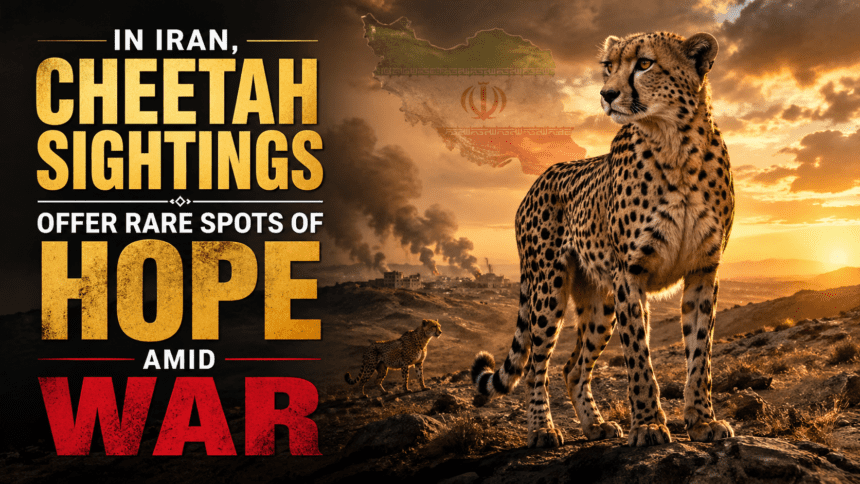
For one brief moment, there was something close to good news. Before the war in Iran upended fieldwork and conservation routines, wildlife rangers in North Khorasan recorded a female Asiatic cheetah with five cubs — an extraordinary sight for a subspecies so close to the edge that even a single healthy litter matters. Reporting on the sighting described it as a first for Iran’s remaining wild population, where litters of that size had not previously been documented.
That is why the image carried so much weight. The Asiatic cheetah now survives only in Iran, and current estimates put the population somewhere between fewer than 30 animals and roughly 30 to 40 individuals, depending on the source and counting method. Either way, the margin is terrifyingly small. Conservation groups and researchers agree on the bigger truth: this is one of the world’s most endangered big cats, and Iran is its last wild stronghold.
The trouble is that the hopeful sighting arrived just before conditions got much worse. Recent conservation reporting says the war has disrupted patrols, camera-trap monitoring, habitat protection and routine field access in areas where the cheetahs hang on. When a population is this tiny, interruptions that might sound temporary on paper can become existential in practice. Missed monitoring means missed births, missed deaths, missed movement patterns — and missed chances to intervene before another setback becomes irreversible.
The species was already in deep trouble long before the fighting. Technical and conservation sources point to the same set of pressures again and again: fragmented habitat, dangerously placed roads, depleted prey, livestock pressure, and very low genetic diversity. A recent scientific review of the cheetah’s stronghold in the Touran Biosphere Reserve also underlined how habitat management, road risk and prey availability remain central to its survival. So the war did not create the crisis. It landed on top of one that was already severe.
There is still a reason people working on the species talk about hope, even now. Iran’s remaining cheetahs are not spread evenly across the country; the most important refuge is the Touran Biosphere Reserve, which conservationists describe as the key landscape for the subspecies. The fact that females are still reproducing in the wild, and that rangers are still finding evidence of family groups, means the species has not slipped into pure biological afterlife yet. It is battered, yes, but not gone.
That hopeful note comes with a harsh qualifier. Small populations can fool people. A rare sighting looks like recovery, and maybe in a narrow sense it is. But conservation biology is cruel that way: one remarkable litter does not erase years of losses, nor does it cancel the danger of a single road collision, a weak prey base or a prolonged breakdown in protection. Even the more optimistic recent figures still describe a population so small that every individual counts in a very literal way.
There is also a broader history hanging over the story. International and Iranian efforts to save the Asiatic cheetah have stretched on for years, including UN-backed work aimed at reversing the decline. But those programs have often had to operate under geopolitical strain, funding limits and administrative disruption. In that sense, the war is not a separate chapter. It is another blow in a long, uneven struggle to keep a species alive in a place where conservation has rarely been allowed to be just conservation.
So yes, the sightings do offer hope. Real hope, not fake sentiment. A female with five cubs is the kind of news conservationists cling to because sometimes that is exactly what survival looks like — not certainty, just a fragile opening. But amid war, the lesson is as sobering as it is uplifting: the cheetahs are still there, still breeding, still fighting on. Whether that remains true may depend on how quickly protection work can stabilize again around one of the rarest big cats left on Earth.