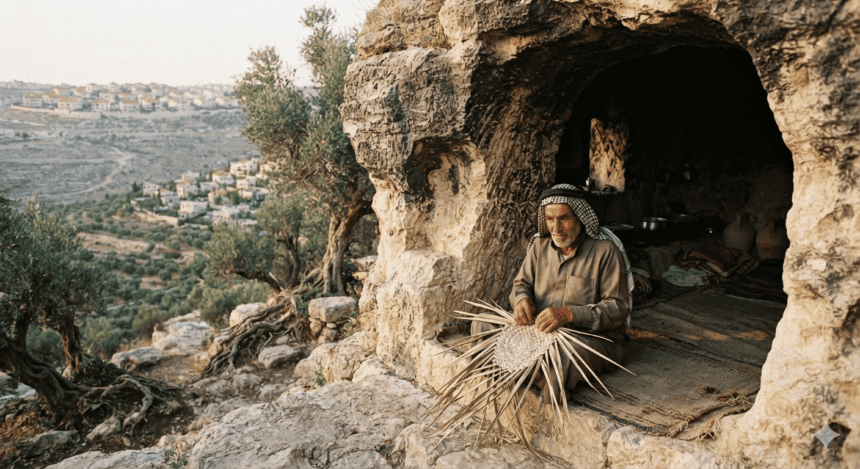
SOUTH HEBRON HILLS — The cave is cool, carved into the limestone bedrock, and it has been home to the Nawaja family for generations. Long before the 1948 establishment of Israel, long before the military occupation of the West Bank in 1967, this family was here.
Today, these caves are at the center of an escalating legal and humanitarian standoff. Israeli authorities designate the area as “Firing Zone 918,” a military training ground. For the Nawaja family, the designation is a thin veil for annexation. They face constant pressure to leave, ranging from demolition orders to the regular cutting of water lines.
“We aren’t squatters on our own land,” says Mahmoud Nawaja, 64, whose family has occupied these hills since the Ottoman era. “They talk about military necessity, but the only thing they’re training for is to make sure we aren’t here tomorrow.”
The legal battle has dragged through the Israeli Supreme Court for over two decades. In 2022, the court finally cleared the way for the military to evict over 1,000 Palestinians from eight villages in the area. Human rights organizations, including B’Tselem, have labeled the ruling a violation of international law, citing the Geneva Convention’s prohibition against the forcible transfer of protected persons in occupied territory.
The “Firing Zone” label is a strategic tool. By reclassifying ancestral grazing lands as military zones, the state effectively criminalizes the traditional semi-nomadic lifestyle of the local Palestinian population. Once the land is declared a closed military zone, the construction of permanent homes is banned, forcing families to rely on caves or temporary structures that can be demolished with a single administrative order.
Life here is a study in friction. Israeli settlements, built on nearby hilltops, enjoy paved roads, electricity, and water infrastructure. Just a few hundred meters away, Palestinian residents haul water in plastic tanks and rely on solar panels that are frequently confiscated by the military for lacking building permits.
For the Nawaja family, the struggle is not just about the limestone walls that have sheltered them for a century. It is about the principle of presence.
“They can tear down the tents and block the cave entrances,” Mahmoud says, looking toward the distant settlement lights. “But they cannot erase the fact that our history is written into the dust of these hills.”
As the military continues its operations, the international community remains largely divided. Meanwhile, the daily reality for the residents of the South Hebron Hills remains unchanged: they wake up, they tend to their flocks, and they wait to see if today is the day their home becomes a memory.