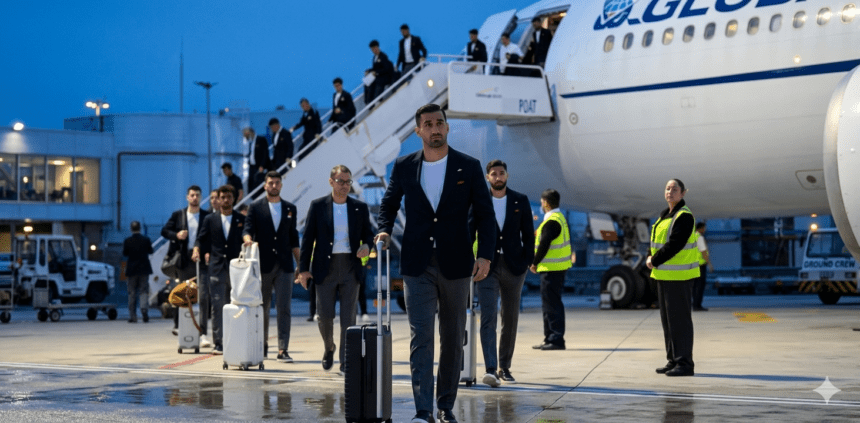
TIJUANA, Mexico — Iran’s national football team arrived in Mexico on Sunday to a warm welcome from a small but passionate group of supporters, kicking off their highly unusual World Cup campaign under a cloud of heavy security and geopolitical tension. The squad, popularly known as “Team Melli,” landed at the Tijuana international airport at 5:00 am, where fans gathered at dawn to catch a glimpse of the players. For local Iranian residents and those traveling across the border from California, the presence of the national team provided a moment of immense pride despite the complex administrative and political challenges放入 overshadowing the tournament.
While the playing squad successfully secured the necessary visas to enter the United States for their group-stage fixtures in Los Angeles and Seattle, the administrative wing of the delegation was heavily impacted by diplomatic friction. Approximately 15 accompanying officials were denied entry visas by Washington. Among those blocked was Islamic Republic of Iran Football Federation (IRIFF) President Mehdi Taj, whose past service in the Islamic Revolutionary Guard Corps (IRGC)—designated a terrorist organization by the U.S. government—triggered strict immigration barriers. The political overlay frustrated arriving fans, who argued that sports should remain isolated from international diplomacy.
The joint hosting of the World Cup by the United States, Mexico, and Canada has subjected the Iranian team to unprecedented operational friction. Following military strikes involving Israel, the United States, and Iran in late February, Team Melli’s participation remained deeply uncertain for months. Never in the history of the tournament has a competing nation been actively engaged in a military conflict with one of the host countries. Although insistence from FIFA eventually solidified Iran’s participation, the Iranian federation abruptly altered its pre-tournament logistical plans two weeks ago due to rising border tensions. The team abandoned its original base in Tucson, Arizona, opting instead to set up camp in Tijuana, Mexico.
The team will undergo training sessions at the Estadio Caliente under a massive security blanket provided by heavily armed Mexican military and police personnel. The tight security framework aims to shield the players from potential unrest, particularly given the polarized political dynamics within the broader Iranian diaspora in nearby Southern California. On the pitch, Iran is slated to compete in a challenging group featuring New Zealand, Belgium, and Egypt, as they chase a historic, first-ever advancement to the World Cup knockout rounds.