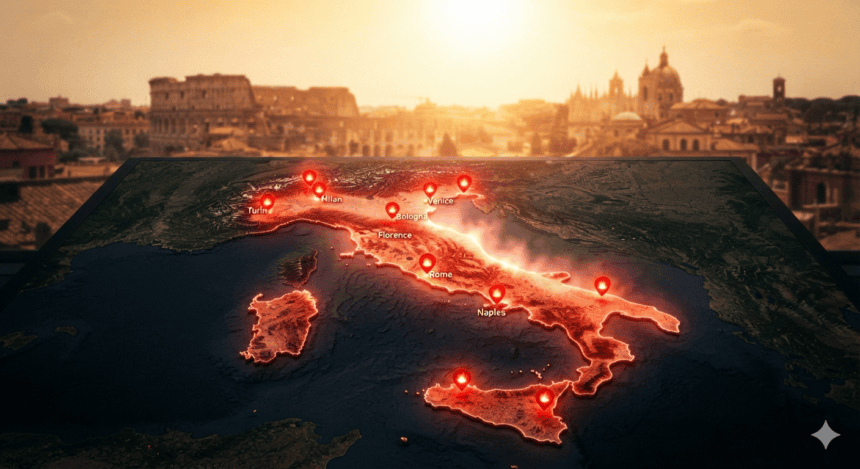
ROME — Italy’s health ministry has issued “red alerts” for nearly all of the country’s major cities this week, as an intense, prolonged heatwave pushes temperatures toward record-breaking highs.
The alert, the highest on the government’s four-tier warning scale, advises residents to avoid direct sunlight between 11 a.m. and 6 p.m. and to limit strenuous physical activity. This warning now covers key urban centers including Rome, Florence, Bologna, and Turin.
In Rome, the mercury is expected to hover around 40°C (104°F) for the next several days. The heat is not merely an inconvenience; it’s a public health crisis. The ministry’s classification warns that the extreme conditions pose a threat to the health of the general population, not just the vulnerable or the elderly.
Hospitals across the peninsula are bracing for an influx of heat-related emergencies. Emergency rooms in the capital have already reported an increase in patients suffering from dehydration and heat exhaustion. Medical staff are urging residents to prioritize hydration and remain in air-conditioned environments where possible.
The heatwave is being driven by an anticyclone moving in from North Africa, trapping hot air over the Mediterranean. Unlike typical summer spikes, this system is proving remarkably stubborn, showing no signs of breaking before the weekend.
Farmers are watching the skies with growing concern. The prolonged heat, coupled with an ongoing lack of significant rainfall in the north, threatens critical crop yields. Water rationing is already in effect in several municipalities in the Po Valley, where irrigation channels have run dangerously low.
This latest surge follows a pattern of increasingly severe summers across Southern Europe. While heatwaves are a historical feature of the Mediterranean climate, the frequency and intensity of these events have forced local authorities to rethink urban planning, with many cities now rushing to expand “green zones” to combat the urban heat island effect.
For now, the advice from the ministry remains blunt: stay indoors, stay hydrated, and check on neighbors who may be struggling in the heat. There is no immediate sign of cooling, and for millions in Italy’s urban centers, the worst of the heat is still to come.