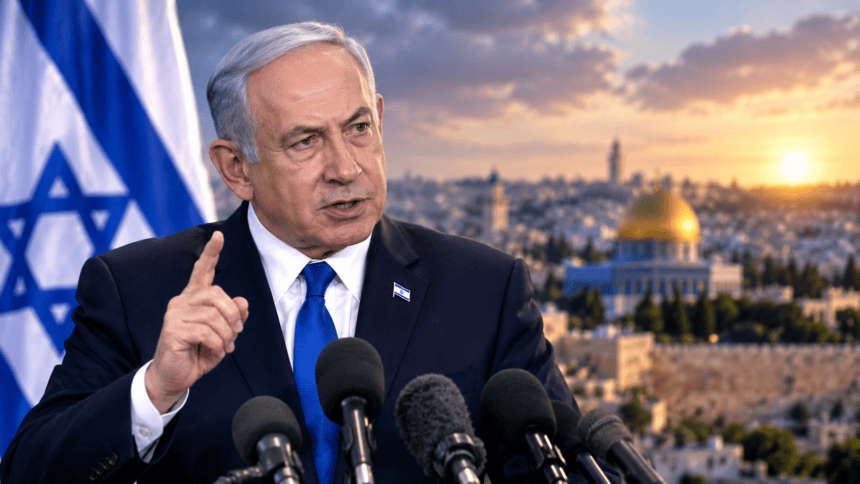
Benjamin Netanyahu issued a stark warning to Israel’s adversaries this week, declaring that the country’s ongoing military operations in Gaza and Lebanon will eventually “change the face of the Middle East.” The Prime Minister’s rhetoric marks a sharp escalation in tone, signaling that Israel is moving beyond tactical responses to Hamas and Hezbollah toward a broader, structural reconfiguration of regional power dynamics.
The declaration comes as the Israel Defense Forces (IDF) expand operations across multiple fronts. In Gaza, the military focus remains on dismantling remaining Hamas battalions, while in the north, the campaign against Hezbollah has intensified, displacing thousands and drawing international calls for a ceasefire.
Netanyahu’s vision hinges on a premise of total security. He frames the current conflict as an existential necessity, arguing that past containment strategies failed to neutralize the threats posed by Iranian-backed proxies. By pushing for a decisive military outcome, the Prime Minister is gambling that he can rewrite the regional security architecture, effectively removing the buffer zones and political leverage these groups have held for decades.
Critics, however, warn that the strategy risks a wider regional conflagration. Regional analysts point out that while military force can degrade militant capabilities, it often fails to account for the political vacuum left in the aftermath. Without a viable post-war governance plan, the promise of a “changed” Middle East may lead to prolonged instability rather than the peace Netanyahu claims to seek.
The administration’s stance has placed it at odds with several Western allies. While the United States continues to provide military support, the Biden administration has repeatedly pressed for a diplomatic exit ramp, fearing that an open-ended regional war will pull U.S. forces into a direct confrontation with Tehran.
Inside Israel, the domestic pressure is mounting. Protesters remain in the streets, demanding that the government prioritize the return of hostages held in Gaza over the broader goal of regional restructuring. Netanyahu’s challenge is twofold: he must maintain the momentum of his military campaign while managing a fragile domestic coalition that is increasingly polarized by the war’s mounting economic and human costs.
The Prime Minister’s ultimatum leaves little room for a return to the pre-October 7 status quo. Whether this shift results in the long-term stability he promises or a deeper cycle of volatility remains the central question facing the region. For now, the military remains the primary instrument of his policy, and the borders of the Middle East are being redrawn in real-time.