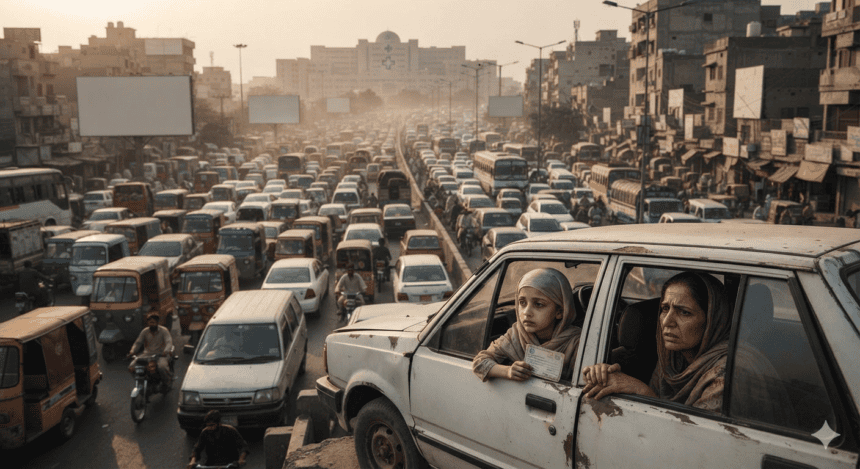
The red lights of an ambulance stalled in a sea of gridlocked cars on Karachi’s Sharea Faisal yesterday, trapping 12-year-old Ayesha—a pediatric cancer patient—as her window for a critical chemotherapy session slipped away.
Traffic across the city’s major arteries ground to a halt for nearly four hours following a series of unannounced protests and road blockades. For Ayesha, who requires precise timing for her medication, the delay wasn’t just an inconvenience; it was a physical setback.
“She was in pain, and every minute in that heat felt like an hour,” her father, Mohammad Iqbal, said. By the time they reached the oncology ward at the Civil Hospital, the facility had already moved to the next patient in the queue.
The city’s infrastructure is buckling under the weight of poor traffic management and a lack of emergency corridors. While ambulances are theoretically granted right-of-way, the reality on Karachi’s streets is a chaotic scramble where sirens are often drowned out by the noise of impatient commuters.
Local authorities cite an increase in construction projects and unauthorized protest sit-ins as the primary drivers of the congestion. Yet, for families navigating the city’s healthcare crisis, those explanations offer little solace.
“We leave two hours early, but you can’t account for a city that refuses to move,” Iqbal added.
Ayesha was eventually admitted late in the evening, though doctors confirmed the delay forced a rescheduling of her primary treatment protocol. As Karachi continues to expand, its streets remain a dangerous gamble for those whose lives depend on reaching a hospital on time.