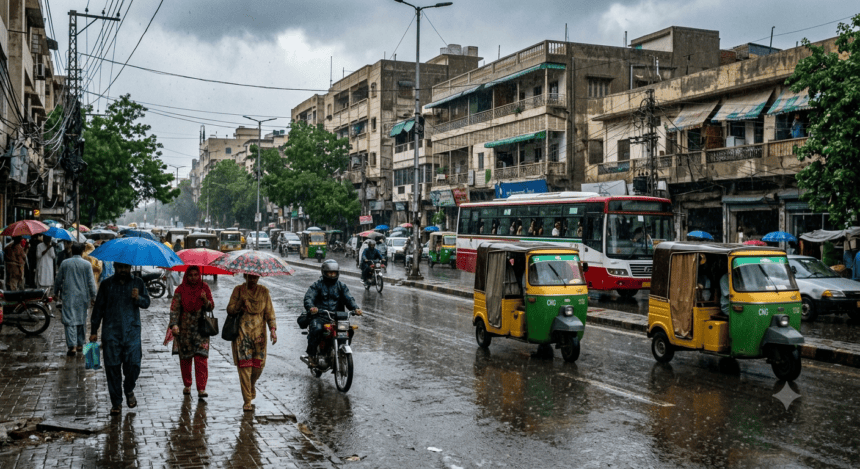
Karachi’s second day of monsoon activity brought persistent light-to-moderate showers across the city Tuesday, turning morning commutes into a slog and stalling traffic in major arteries. While the rainfall lacked the intensity of a cloudburst, it was enough to expose the city’s persistent drainage failures.
The Met Office recorded the highest accumulation in areas like Saddar, I.I. Chundrigar Road, and Gulshan-e-Iqbal. By 10:00 a.m., the drizzle had transitioned into a steady downpour, catching many residents off guard as they navigated slick roads and the inevitable urban flooding that follows even minor precipitation in the metropolis.
For the average commuter, the “so what” is immediate: gridlock. Areas surrounding the University Road and Sharea Faisal saw vehicle speeds drop to a crawl as stagnant water began pooling in low-lying pockets. The city’s aging infrastructure, already strained by years of neglect, struggled to manage the runoff, leaving pedestrians to wade through murky water just to reach public transport hubs.
“We see the same cycle every time the clouds gather,” said Mohammad Rizwan, a daily commuter who works in the city’s financial district. “The rain is a blessing, but for us, it’s just a delay that costs us hours of our day.”
Municipal authorities have been quick to claim that drainage systems were cleaned ahead of the season, yet the reality on the ground tells a different story. In neighborhoods like Surjani Town and Orangi, residents reported water entering homes as the local nullahs—many still clogged with construction debris and solid waste—failed to channel the flow effectively.
Meteorologists expect the current system to persist for at least another 24 hours, with intermittent showers likely to continue through Wednesday. The provincial disaster management authority has issued a standard advisory urging residents to stay clear of power poles and billboards, though for those living in the city’s more vulnerable districts, safety is rarely a choice.
As the humidity spikes and the sky remains gray, the city is left waiting for the rain to stop—and for a long-term solution to a seasonal problem that never seems to leave.