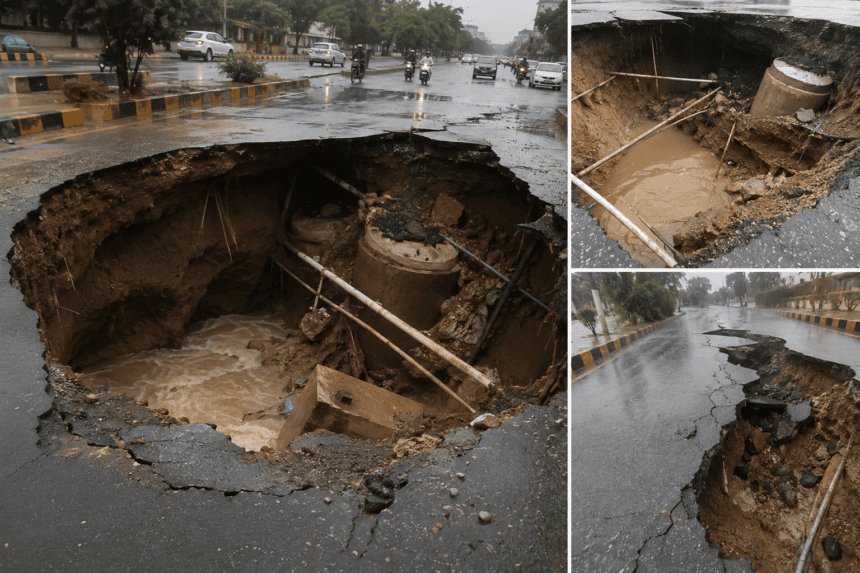
The newly constructed Khayaban-e-Firdousi road in Lahore collapsed Tuesday, just hours after the city’s first monsoon spell. The massive sinkhole appeared near the Shaukat Khanum intersection, swallowing a portion of the multimillion-rupee infrastructure project that was inaugurated with great fanfare only months ago.
Commuters were left stranded as the asphalt gave way, creating a crater that exposed the underlying drainage pipes and sewage lines. Traffic police cordoned off the area, diverting thousands of vehicles toward alternate routes, leading to gridlock across the Johar Town and Wapda Town vicinities.
For residents, the collapse isn’t a surprise—it’s a pattern. The project, which cost taxpayers over Rs. 2 billion, was marketed by the provincial government as a “state-of-the-art” solution to the area’s chronic traffic congestion. Critics had long pointed to the rapid pace of construction, alleging that quality checks were bypassed to meet political deadlines.
“We watched them rush the laying of the road during the final weeks,” said a local shopkeeper who witnessed the sinkhole form. “When you build in a hurry just to cut a ribbon, this is what you get.”
Engineering experts point to two likely failures: poor soil compaction and substandard drainage design. The heavy rainfall simply revealed what was already compromised underneath the surface. The road, designed to handle heavy traffic flow, couldn’t withstand a single day of moderate downpour.
The Lahore Development Authority (LDA) has yet to issue a formal explanation regarding the contractor’s liability. Typically, such projects include a defect liability period, meaning the construction firm should be responsible for the repair costs. However, in the past, these firms have often walked away unscathed while the public treasury bears the burden of “re-repairs.”
As of Tuesday evening, heavy machinery was seen moving toward the site, but the damage to the city’s credibility is already done. The collapse highlights a recurring failure in Lahore’s urban planning: prioritizing high-visibility infrastructure over the essential, invisible work of drainage and foundation integrity.
With more rain in the forecast for the coming week, the question remains whether other sections of the multi-billion rupee road network will hold—or if this sinkhole is just the first of many.