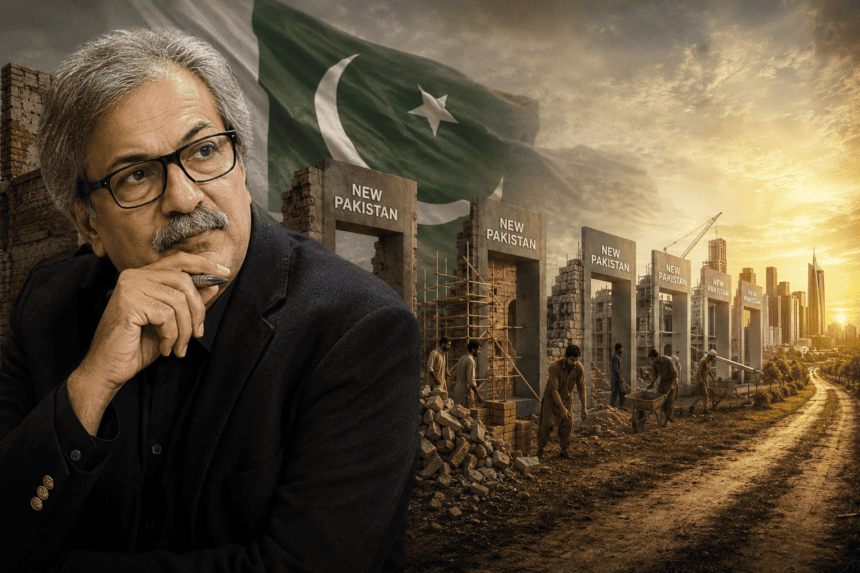
Veteran journalist Mazhar Abbas has issued a sharp critique of the country’s political culture, arguing that the recurring promise of a “new Pakistan” has become a hollow mantra that masks a failure to address systemic rot.
Speaking on the nature of political transitions in the country, Abbas pointed to a recurring pattern: every few years, a new leadership promises a fresh start, only to revert to the same governance failures that plagued their predecessors. This cycle, he argues, isn’t just a political strategy—it’s a distraction that prevents real, structural reform.
The “New Pakistan” narrative is rarely about policy shifts or institutional strengthening. Instead, it serves as a convenient reset button for elites. By framing the country as a blank slate, leaders avoid accountability for past promises. It’s an effective way to generate short-term public enthusiasm while bypassing the tedious, unglamorous work of fixing the tax base, the judiciary, or the police.
Abbas’s observation touches a nerve because it resonates with the public’s exhaustion. Citizens have heard the promise of a “New Pakistan” from multiple regimes over the last two decades. Each time, the rhetoric arrives with high expectations, followed by the same economic stagnation and political infighting. When the “new” eventually wears off, the country finds itself in the same place—or worse.
The danger of this cycle is the erosion of public trust. When “change” becomes a brand rather than a goal, voters eventually stop believing in the possibility of any reform at all. This cynicism doesn’t just hurt the politicians; it hollows out the state’s legitimacy.
Real change, according to Abbas, requires more than a slogan. It demands an honest reckoning with why previous attempts failed. Until the political class stops trying to reinvent the country every five years and starts fixing the foundations they inherited, the “new” will remain nothing more than a fresh coat of paint on a crumbling structure.
Ultimately, the persistent rebranding of Pakistan suggests a leadership class more interested in the aesthetics of power than the mechanics of governance. As Abbas suggests, the country doesn’t need another “new” beginning—it needs someone to finally finish the work they started.