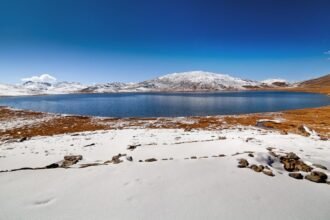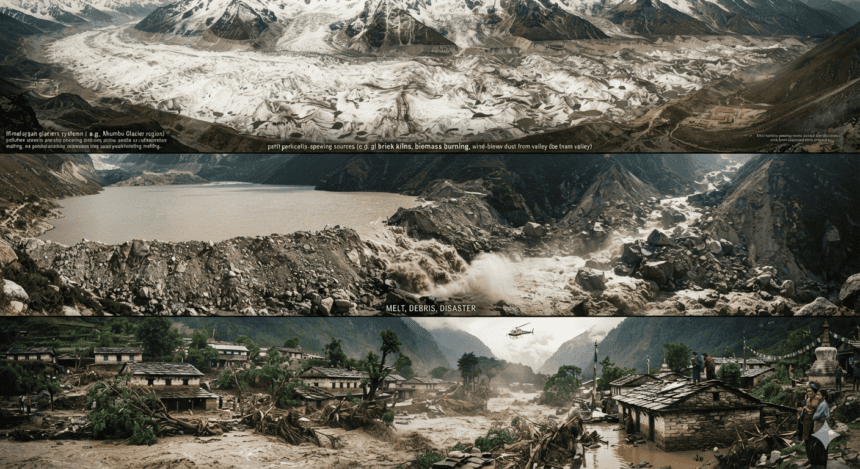
The ice-capped peaks of the Himalayas are losing their stability. A new study confirms that warming temperatures in Nepal and Tibet are accelerating glacial melt, not just shrinking the ice, but creating unstable lakes that risk bursting their banks and triggering catastrophic floods downstream.
These glacial lakes—often held back by fragile walls of rock and debris—are filling faster than ever. When these natural dams fail, the resulting “glacial lake outburst floods” (GLOFs) send millions of cubic meters of water, mud, and boulders crashing into mountain villages. The window to prepare is closing.
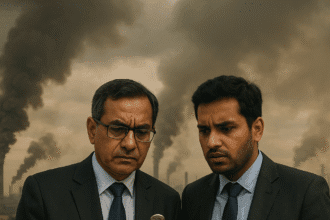
Climate researchers tracking the region point to a specific danger: black carbon. Soot from seasonal crop burning and industrial activity in South Asia is drifting upward, settling on the white snow of the Tibetan Plateau and the Himalayas. This dark layer absorbs more sunlight, accelerating the melting process far beyond what rising air temperatures alone would cause.
“The landscape is changing in real-time,” said Dr. Sonam Wangyal, a hydrologist who has spent years monitoring the Dudh Koshi basin. “We aren’t just talking about long-term sea-level rise anymore. We’re talking about a wall of water hitting a village in a matter of minutes.”
The human cost is already mounting. In recent years, communities in the Solu-Khumbu region of Nepal have seen erratic monsoon patterns leave their infrastructure vulnerable. Bridges, power plants, and schools built on riverbanks—once considered safe—are now in the direct path of potential flash floods.
Local governments face a difficult reality. Building reinforced concrete dams to hold back these lakes is expensive, logistically difficult in high-altitude terrain, and often politically fraught between neighbors like China and Nepal. Early warning systems exist, but they rely on sensors that are frequently destroyed by the very landslides they are meant to predict.
For the thousands living in the shadows of these peaks, the risk is no longer a theoretical climate model. It’s a seasonal reality. As the glaciers continue to thin, the mountains are holding less ice and more water, leaving downstream populations waiting for a disaster that has no set time, only a location.