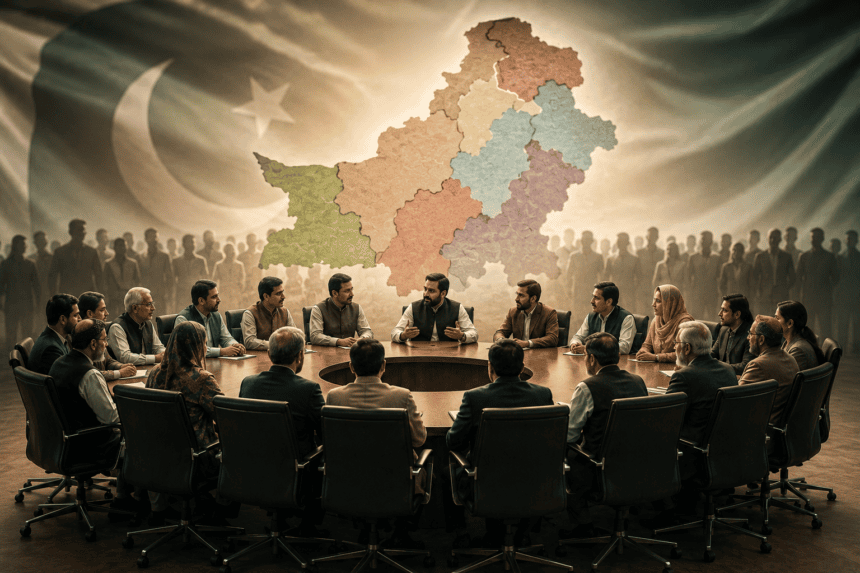
KARACHI — The Muttahida Qaumi Movement-Pakistan (MQM-P) has officially reignited the debate over administrative restructuring, calling for a national dialogue to establish new provinces across the country. The party, which holds significant sway in urban Sindh, argues that the current administrative model has failed to deliver basic services to the grassroots level.
Senior party leaders pushed the agenda during a press conference in Karachi this week, framing the creation of new provinces as a constitutional necessity rather than a political maneuver. They contend that the existing provincial boundaries are too expansive, leading to governance deficits that leave remote districts neglected.
“We aren’t talking about division for the sake of it,” a senior MQM-P spokesperson told reporters. “We are talking about the survival of the federation. When people in the periphery feel abandoned by provincial capitals, the state loses its moral authority.”
The proposal specifically targets the administrative burden in Sindh, though the party’s rhetoric suggests a broader national framework. Critics, however, remain skeptical. Many analysts view the timing of the demand as a strategic move to regain political relevance following recent electoral setbacks and the party’s ongoing struggle to maintain its grip on urban centers.
The Pakistan Peoples Party (PPP), which has governed Sindh for over a decade, has historically opposed any move to carve out new administrative units. For the PPP, such demands are often viewed as attempts to undermine provincial autonomy and weaken their political stronghold.
Beyond the political sparring, the constitutional path to creating a new province is notoriously difficult. It requires a two-thirds majority in both the National Assembly and the provincial assembly of the province being divided. Given the current parliamentary arithmetic, reaching such a consensus is unlikely in the near term.
The MQM-P’s push comes as the country faces mounting economic pressure and growing public frustration over centralized governance. By elevating this issue, the party is betting that the demand for localized power will resonate with voters who feel sidelined by the existing system.
Whether the call for a “national dialogue” gains momentum or serves merely as a tactical talking point remains the central question. For now, the proposal sits on the table, highlighting the deep-seated friction between those advocating for administrative reform and those protective of existing provincial boundaries.