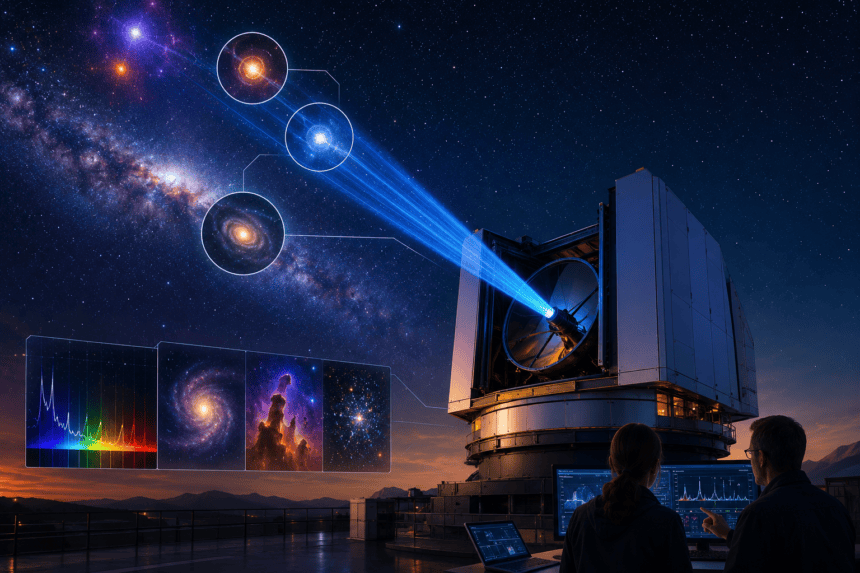
The next generation of space exploration isn’t just about bigger mirrors or longer distances. It’s about precision. Scientists have finalized a new instrument design capable of isolating the faint, infrared signatures of gas clouds where stars are born, effectively stripping away the cosmic dust that has blinded telescopes for decades.
This technology—known as the High-Resolution Spectro-Polarimeter—is designed to detect magnetic field alignments within stellar nurseries. For years, astronomers have observed these clouds, but the internal “weather” of these regions remained a black box. By measuring how light waves twist as they pass through dense dust, researchers can now map the magnetic forces governing star formation.
“We’ve been looking at the surface of a drum for years,” says Dr. Elena Rossi, an astrophysicist at the European Southern Observatory. “Now, we finally have the tools to see what’s hitting the skin from the inside.”
The stakes for this research go beyond simple curiosity. Understanding how stars form helps explain why some solar systems develop rocky, Earth-like planets while others end up as gas giants. Current models often struggle to account for the chaotic magnetic turbulence during a star’s infancy. This instrument bridges that gap by providing data points that were previously impossible to capture.
The device is slated for integration into the next wave of orbital missions. Unlike its predecessors, which required massive amounts of post-processing to clarify images, this instrument processes polarization data in real-time. It doesn’t just take pictures; it builds a structural blueprint of a star’s environment as it coalesces.
Critics have pointed to the immense budget required for such high-precision sensors, noting that the cost-to-data ratio is higher than traditional optical cameras. Yet, the scientific community argues the trade-off is necessary. Without this level of detail, we are merely guessing at the conditions that allow life-sustaining systems to emerge.
The first test runs are scheduled for late next year. If the hardware performs as the prototypes suggest, the view of the Orion Nebula and other active star-forming regions will change overnight. We aren’t just looking at stars anymore; we’re watching the clockwork of the universe turn.