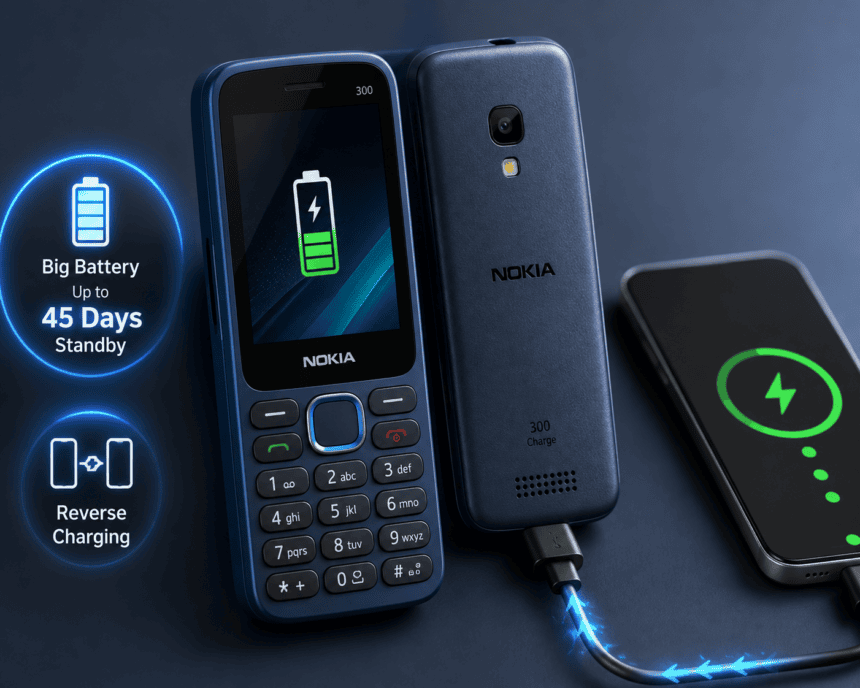
HMD Global has officially unveiled the Nokia 300 Charge, a device centered entirely around a 6,000mAh battery. The phone aims to bridge the gap between long-lasting utility and modern connectivity, banking on the growing consumer frustration with daily charging cycles.
The headline feature is the power cell. While most smartphones struggle to finish a second day of moderate use, the 300 Charge promises up to three days of operation on a single charge. HMD has paired this with 45W fast charging, ensuring that filling a battery of this size doesn’t require an overnight stay on the charger.
Reverse charging is the secondary play here. The handset doubles as a power bank, allowing users to charge wearables or wireless earbuds on the move. It’s a practical inclusion for travelers or field workers who carry multiple devices but rarely have access to a wall outlet.
Internal specs remain functional rather than flagship-grade. The device runs on a mid-tier processor optimized for power efficiency rather than raw gaming performance. The display is a 6.7-inch FHD+ panel with a 90Hz refresh rate—a standard choice that balances visual smoothness with the need to conserve energy.
Industry analysts suggest HMD is carving out a specific niche. By prioritizing battery capacity over high-end camera sensors or bleeding-edge silicon, the company is targeting users who view their phone as a tool for endurance. It’s a direct response to the “battery anxiety” that continues to plague the mobile market.
The 300 Charge enters a crowded mid-range segment where competitors often sacrifice battery life for slimmer aesthetics. HMD isn’t chasing the thinnest profile; the device feels substantial in the hand, a design trade-off that the manufacturer expects its target audience to accept.
Pricing starts at $299, positioning the phone against budget offerings from Xiaomi and Samsung. With global availability starting next month, HMD will soon find out if the market still values longevity over the pursuit of the thinnest possible chassis.