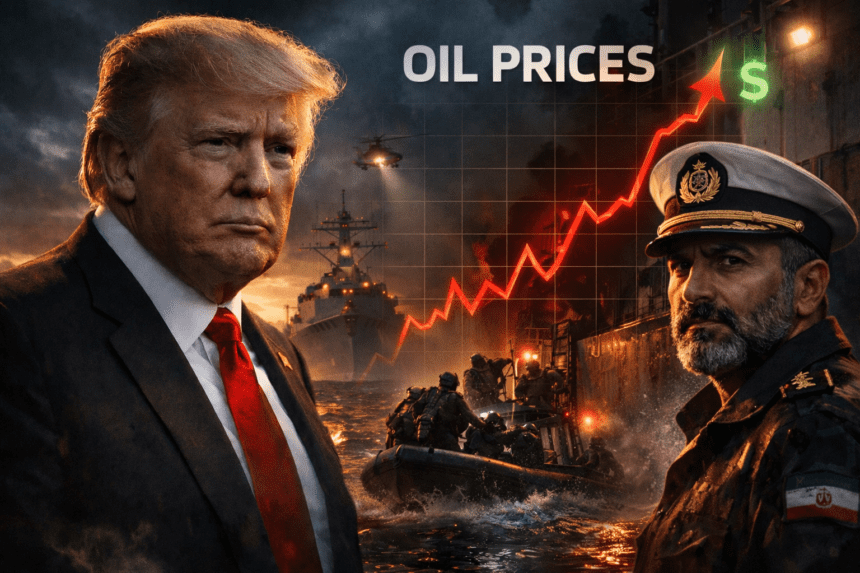
Oil prices climbed sharply on Sunday after President Donald Trump said U.S. forces had seized an Iranian cargo vessel, a move that instantly sharpened market anxiety over the Strait of Hormuz and the risk of a wider supply shock. The waterway, already under intense strain after weeks of confrontation, is one of the world’s most critical oil transit routes, so even a single military incident there tends to hit prices fast.
According to multiple reports, the ship identified as the Touska was intercepted after U.S. warnings were ignored during an attempt to pass through waters affected by Washington’s blockade measures. The Washington Post reported that the USS Spruance disabled the vessel before U.S. Marines boarded it, while Trump later publicly confirmed the seizure. Iran, for its part, condemned the action as piracy and signaled retaliation, raising fresh doubts about already shaky diplomatic contacts.
That was enough to rattle energy markets almost immediately. AP reported U.S. crude rising 6.4% to $87.90 a barrel and Brent climbing 5.8% to $95.64, while other live coverage on Monday showed prices moving even higher as the standoff worsened, with West Texas Intermediate near $90.17 and Brent around $96.27. The variation reflects fast-moving trading through the day, but the direction was clear: traders were pricing in a bigger geopolitical risk premium.
The bigger concern isn’t just one ship. It’s what the seizure says about the next few days. The Strait of Hormuz has been at the center of this crisis for weeks, with tanker traffic disrupted, ceasefire efforts wobbling, and shippers already nervous about insurance costs, rerouting, and outright delays. AP described the latest confrontation as part of a broader U.S.-Iran standoff that has stranded tankers and helped drive one of the worst energy shocks in years.
There’s also a diplomatic angle here, and it’s messy. Reports said the seizure came just as U.S. officials were expected to pursue talks in Pakistan, but Iran indicated it may refuse to participate under current conditions. That leaves the market stuck between two possibilities: a narrow crisis that cools down quickly, or a deeper confrontation that threatens shipping through Hormuz for longer than traders had hoped. Right now, frankly, the market seems to be betting that calm is still some distance away.
For consumers, the implications could spread well beyond oil traders’ screens. AP reported the U.S.-Iran conflict has already pushed average U.S. gasoline prices to about $4.05 a gallon, up notably from prewar levels. And because Hormuz is such a choke point for global crude flows, import-dependent economies in Asia and Europe are especially exposed if shipping disruptions drag on.
In plain terms, this is why the market reacted so quickly: when military action edges closer to a vital oil artery, traders don’t wait around for perfect clarity. They buy the risk first and sort out the details later.