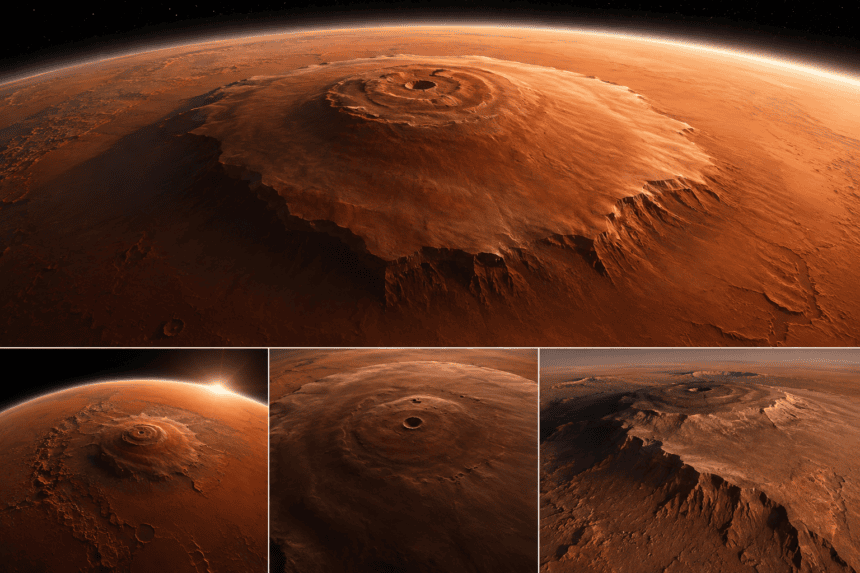
Scientists have uncovered new clues about Olympus Mons, the largest volcano in the Solar System, offering fresh insights into its formation, geological history, and the volcanic processes that shaped ancient Mars. The latest research is helping planetary scientists better understand how this colossal volcano grew to an unprecedented size.
Using high-resolution images, topographic maps, and data from orbiting Mars spacecraft, researchers analyzed the volcano’s slopes, lava flows, and surrounding terrain. The findings reveal new details about the eruptions that built Olympus Mons over millions of years and how the volcano evolved.
Olympus Mons is located on Mars and rises approximately 22 kilometers (14 miles) above the surrounding plains, making it nearly three times taller than Mount Everest when measured from its base. The volcano spans about 600 kilometers (370 miles) across and is surrounded by towering cliffs in some areas.
Scientists believe Olympus Mons became so massive because Mars lacks active plate tectonics. Unlike Earth, where tectonic plates constantly move and carry volcanoes away from their magma sources, the Martian crust remained largely stationary, allowing repeated lava eruptions to build the volcano in the same location over an extremely long period.
The study also suggests that parts of Olympus Mons may have remained volcanically active much longer than previously thought. Ancient lava flows and surface features indicate that eruptions occurred over extended periods, although the volcano is considered dormant today.
Researchers are investigating whether volcanic heat may once have influenced the Martian climate or created temporary environments where liquid water could have existed beneath the surface. These findings could help scientists better understand Mars’ geological evolution and its potential to have supported habitable conditions in the distant past.
Experts say studying Olympus Mons not only improves our understanding of Mars but also provides valuable insights into volcanic activity on rocky planets across the universe.
Future Mars missions and advanced orbiters are expected to uncover even more about the structure, history, and evolution of this extraordinary volcanic giant.