Astronomers have captured a rare glimpse of a new star being born, offering valuable insights into one of the most important processes in the universe. The latest observations are helping scientists better understand how stars form from vast clouds of gas and dust and evolve over millions of years.
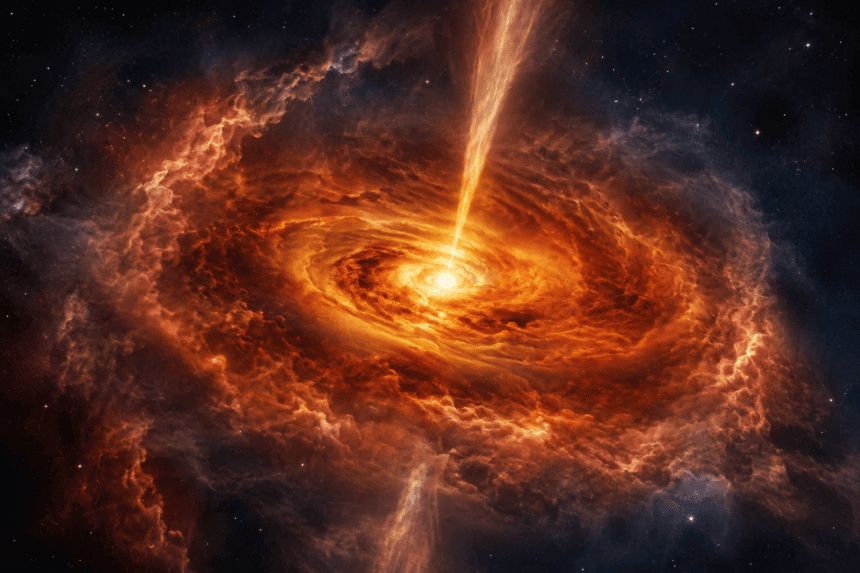
Using powerful space- and ground-based telescopes, researchers observed a dense molecular cloud where gravity is causing gas and dust to collapse inward. The study revealed a young protostar surrounded by a rotating disk of material that will continue feeding the growing star.
Scientists explain that stars are born inside enormous stellar nurseries, where cold clouds of hydrogen and dust gradually collapse under their own gravity. As the material compresses, temperatures and pressure rise until nuclear fusion begins in the star’s core, marking the birth of a new star.
The observations also detected powerful jets of gas streaming away from the young star at high speeds. These jets help remove excess material and angular momentum, allowing the protostar to continue growing while shaping the surrounding cloud.
Researchers say studying newborn stars provides important clues about how planetary systems, including our own Solar System, are formed. The disks surrounding young stars are believed to be the birthplace of future planets, moons, and other celestial bodies.
The findings improve scientists’ understanding of stellar evolution and the complex physical processes that govern star formation throughout the universe.
Experts believe future observations with next-generation telescopes will reveal even more details about the earliest stages of a star’s life, bringing humanity closer to understanding how stars and planetary systems come into existence.