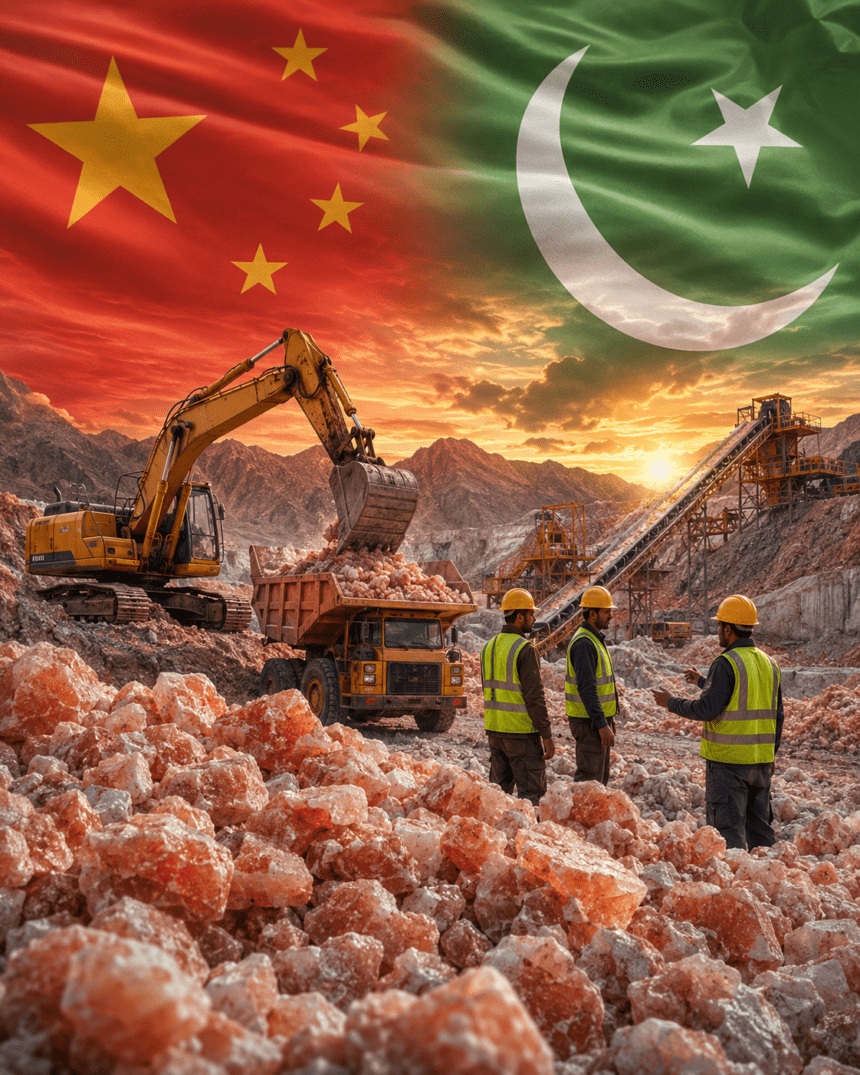
BEIJING: Pakistan and China have signed a strategic cooperation agreement aimed at expanding Pakistan’s rock salt mining, processing and international exports, in what officials are calling a major step toward giving the country’s mineral sector a stronger place in global supply chains.
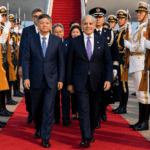
The agreement was signed on May 21, 2026, at the Embassy of Pakistan in Beijing between Pak Salt Corporation (Private) Limited and China National Salt Industry Group, commonly known as CNSIG. Pakistan’s Ambassador to China Khalil Hashmi was present at the ceremony.
Pak Salt Corporation is a joint venture between Pakistan Mineral Development Corporation and Miracle Salt Development Corporation, while CNSIG is one of China’s major state-owned salt industry enterprises. The deal sets up a long-term cooperation framework covering the full salt value chain — from exploration and mining to processing, value addition, branding and international distribution.
For Pakistan, the agreement matters because the country has long exported much of its rock salt in raw or low-value form, even though Pakistani pink salt is sold in premium markets around the world. Officials say the new framework is meant to change that equation by building more processing capacity inside Pakistan and helping Pakistani-origin salt products reach organized consumer and industrial markets abroad.
The initiative was facilitated by the Special Investment Facilitation Council, which has been working to attract foreign investment into mining, agriculture, energy and other priority sectors. According to details shared at the signing ceremony, the partnership will involve institutional, technical and commercial cooperation to help commercialize Pakistan’s rock salt reserves in a more structured way.
The timing is important. Pakistan’s salt exports to China have already been rising. Official data cited by Pakistan’s trade officials showed exports of salt to China reached $3.44 million from January to May 2025, up from $2.50 million during the same period a year earlier — a jump of 38 percent.
Earlier figures also showed Pakistan exported over 13.64 million kilograms of salt to China in the first quarter of 2025, generating $1.83 million, compared with $1.30 million in the same period of 2024. Pakistan has been exporting salt to China under categories including edible salt, pure sodium chloride and other salt products.
The global appeal of Pakistani pink salt has grown sharply in recent years, especially in food, wellness, decorative and spa-related markets. Much of this salt is mined in Punjab’s Salt Range, including the famous Khewra Salt Mine, which remains one of Pakistan’s best-known mineral assets. Business Insider reported in April 2026 that the global Himalayan pink salt market was valued at about $523 million in 2025 and was projected to approach $700 million by 2030, while noting that Pakistan is a central supplier of the product.
Still, Pakistan’s challenge has never been the absence of salt. It has been value. For years, traders and industry observers have argued that Pakistan loses potential revenue when raw salt is exported cheaply and later packaged, branded and sold at far higher prices in foreign markets. This new agreement appears designed to tackle exactly that problem: more finished products, more local processing, and hopefully, better margins.
Officials believe Chinese technology, distribution networks and industrial experience could help modernize Pakistan’s salt sector. If the cooperation moves beyond paperwork into actual investment, it may support new processing plants, improved mining standards, better packaging, and stronger access to retail and industrial buyers overseas.
There are still questions, of course. The agreement lays out a cooperation framework, but the real test will be implementation: how much investment comes in, where new facilities are built, how local miners and processors benefit, and whether Pakistan can protect its own branding in global markets.
For now, Islamabad and Beijing are presenting the pact as another sign of deepening economic cooperation beyond traditional infrastructure projects. And for Pakistan’s mineral industry, frankly, it’s a chance to do something it has talked about for years — stop selling a premium natural resource too cheaply and start earning from the finished product.