
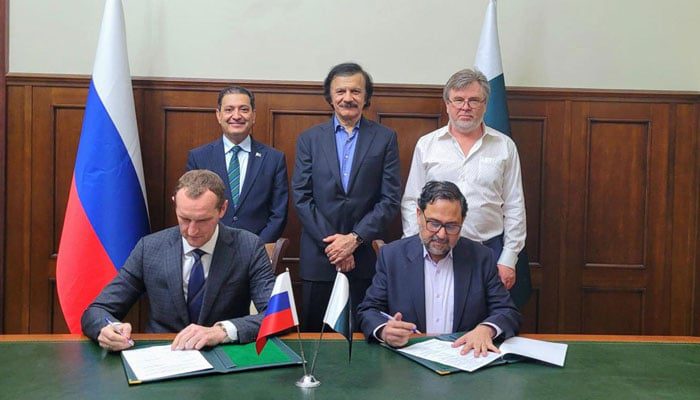
In a significant boost to bilateral industrial cooperation, Pakistan and Russia have signed a landmark agreement to revive and modernise the long-dormant Pakistan Steel Mills (PSM), reaffirming their decades-old partnership in heavy industry.
The agreement, signed at the Pakistan Embassy in Moscow, was inked by Saif Anjum, Secretary of Pakistan’s Ministry of Industries and Production, and Vadim Velichko, General Director of Russia’s Industrial Engineering LLC. The signing took place in the presence of Special Assistant to the Prime Minister (SAPM) Haroon Akhtar Khan and Pakistan’s Ambassador to Russia Muhammad Khalid Jamali, according to an official press release.
Revival with a Vision
The agreement paves the way for a comprehensive restoration and technological overhaul of the PSM, located in Karachi. The mill, which was originally built with Soviet assistance in the 1970s, has remained non-functional since June 2015 and has long been a financial burden on the national exchequer.
“This initiative reflects our shared industrial history and a strong commitment to a robust industrial future,” said SAPM Haroon Akhtar during the signing ceremony. “Reviving the steel mills with Russian support is not just about restarting operations it’s about reigniting the dream of national industrial self-reliance.”
Modernisation and Expansion
Under the project, the existing PSM infrastructure will be dismantled and replaced with a modern, state-of-the-art facility. The federal government has allocated 700 acres of land to the Sindh government for the development of the new steel plant, while adjoining land will be earmarked for an industrial park, enhancing the project’s long-term economic impact.
The initiative builds on a framework agreement signed in May 2025, under which Islamabad and Moscow agreed to jointly establish a new-generation steel production facility in Karachi, capable of catering to both domestic and export markets.
Strategic Alignment
The agreement comes amid a flurry of diplomatic engagements between the two countries, with Russian Deputy Prime Minister Alexei Overchuk recently calling Pakistan and Russia “natural allies” in economic and energy domains.
On the sidelines of the 32nd ASEAN Regional Forum Ministerial Meeting in Kuala Lumpur, Pakistan’s Deputy Prime Minister and Foreign Minister Senator Ishaq Dar met with his Russian counterpart Sergey Lavrov, reaffirming the desire to deepen cooperation across key sectors.
“The two ministers agreed to hold further talks next week during the SCO Council of Ministers meeting,” said Pakistan’s Foreign Office.
Meanwhile, Tariq Fatemi, SAPM on Foreign Affairs, visited Moscow for the second time this year to help finalise key elements of the steel mills project. Discussions also explored broader economic collaboration, including energy, infrastructure, and trade development.
A New Chapter
The signing of this agreement is being hailed as a milestone in Pakistan-Russia relations, promising a long-term revival of domestic steel production, job creation, and a new wave of industrial growth for Pakistan.
Officials from both sides expressed optimism that the project will be fast-tracked in the coming months, with a strong emphasis on technology transfer, local employment, and bilateral technical expertise.
“This isn’t just about reviving a steel mill it’s about shaping a new industrial vision for Pakistan,” said SAPM Haroon Akhtar, underlining the strategic nature of the venture.