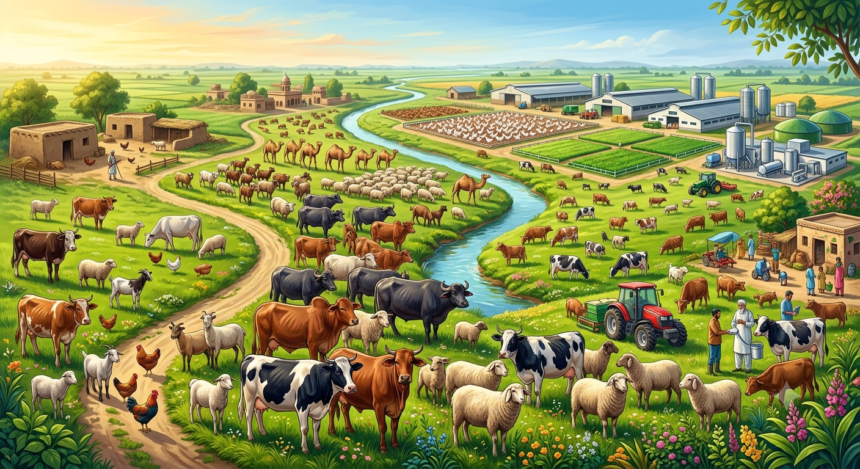
Pakistan’s livestock sector has surged by 89% over the last 18 years, evolving from a traditional rural livelihood into a massive economic engine. Official data confirms the industry’s output has nearly doubled since 2006, shifting the country’s agricultural landscape as the sector now contributes more to national GDP than major crops like wheat and cotton.
The growth hasn’t been uniform. It’s been driven by a steady rise in meat and milk production, fueled by increased urban demand and a gradual shift toward commercial farming models. For a country that relies on agriculture for roughly 24% of its GDP, this expansion isn’t just a statistic; it’s the primary safety net for millions of small-scale farmers facing climate-induced volatility in crop yields.
Yet, the raw growth numbers mask persistent inefficiencies. While the sector is expanding, it remains largely unorganized. Most of the value chain—from feed quality to cold-chain logistics—still operates on outdated practices. A significant portion of the milk produced never reaches commercial processing plants, leading to massive post-harvest losses that keep retail prices high despite the volume of production.
Economic analysts point out that despite this 89% jump, Pakistan’s share in the global Halal meat market remains surprisingly small. Export potential is hampered by sanitary and phytosanitary standards that have failed to keep pace with international requirements. While the volume is there, the value-addition process remains stagnant, leaving the country a net importer of high-end dairy and meat products.
The government’s recent focus on “corporate agriculture” aims to bridge this gap. By encouraging private investment in livestock breeding and disease control, policymakers hope to move beyond quantity and toward export-grade quality. However, small farmers—who own the vast majority of the national herd—remain skeptical, fearing that large-scale corporate entry may squeeze them out of the market rather than provide the technical support they need.
For now, the sector remains the backbone of the rural economy. Whether this trajectory can be sustained depends on how quickly the industry can modernize its processing infrastructure. Without a shift toward value-addition, the next two decades might show growth in numbers, but not necessarily in the wealth of those actually raising the livestock.