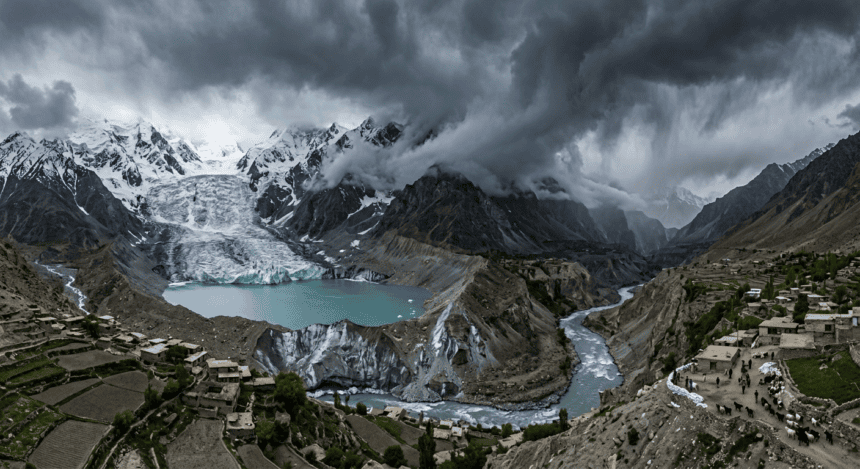
The Pakistan Meteorological Department (PMD) has issued an urgent alert for Gilgit-Baltistan and Khyber Pakhtunkhwa, warning that a new westerly wave will likely trigger Glacial Lake Outburst Floods (GLOF) across the region.
Temperatures are expected to rise significantly before the precipitation begins, a combination that meteorologists say creates a “perfect storm” for glacial melt. The alert covers vulnerable valleys where infrastructure remains fragile following previous monsoon seasons.
District administrations in high-risk areas have been told to clear drainage channels. Local residents, particularly those living near glacial streams, are being asked to monitor water levels closely over the next 48 to 72 hours.
The PMD’s latest advisory notes that the incoming weather system will bring heavy rain and gusty winds, likely accelerating the melting process of snow and ice in the high-altitude zones. This rapid runoff often leads to flash flooding in downstream communities that have little time to react when a natural dam breaches.
Past incidents have shown how quickly these events unfold. A breach in a glacial lake can release millions of cubic meters of water and debris in minutes, washing away roads, bridges, and agricultural land.
While the PMD maintains constant satellite surveillance of these glacial lakes, the margin for error is razor-thin. Officials are emphasizing that emergency response teams in Skardu, Chitral, and Swat should remain on high alert through the weekend.
Beyond the immediate flood risk, the weather system is expected to drop temperatures sharply once the rain sets in, providing a brief respite from the pre-storm heat. However, the primary focus remains on the structural integrity of the glacial basins and the safety of the downstream populations.