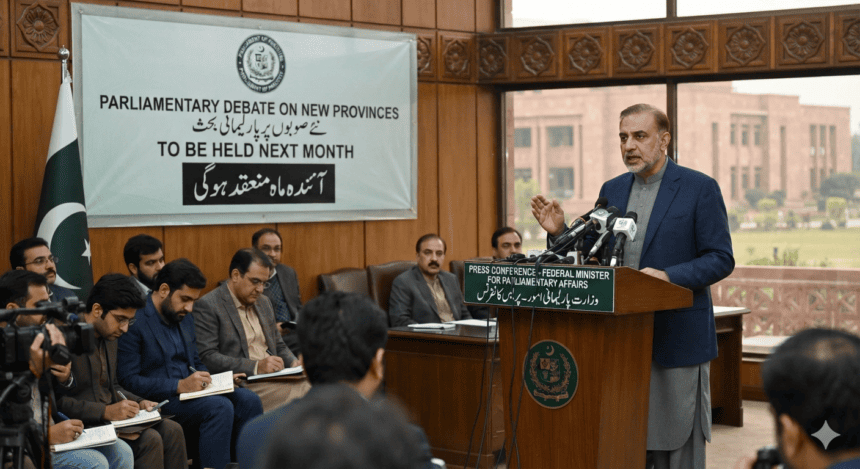
Parliament will take up the contentious issue of creating new provinces during next month’s session, according to the Minister for Parliamentary Affairs. The announcement follows months of mounting pressure from regional political factions, particularly in South Punjab and parts of Khyber Pakhtunkhwa.
The minister confirmed the development during a brief exchange with reporters, framing it as a necessary step to address long-standing administrative grievances. He stopped short of detailing a specific roadmap for legislative changes, leaving the scope of the debate open to interpretation by opposition benches.
For years, the demand for provincial autonomy has been a political football. Proponents argue that smaller administrative units improve governance and resource distribution. Critics, however, fear the push is less about efficiency and more about political maneuvering to secure regional power bases ahead of the next electoral cycle.
The constitutional path to creating a new province is arduous. It requires a two-thirds majority in both houses of parliament—a hurdle that has stymied previous attempts for decades. Without a broad consensus between the government and the major opposition parties, the upcoming debate risks becoming another performative exercise rather than a legislative breakthrough.
Constitutional experts point to the 18th Amendment as the primary framework that complicates this process. Shifting boundaries requires not just a simple vote, but a complex renegotiation of fiscal transfers and administrative control that the current federal structure is ill-equipped to handle quickly.
The minister’s timeline sets the stage for a volatile session. Whether the government can move beyond rhetoric to build a genuine cross-party coalition remains the central question. Until a concrete bill is tabled, the debate will likely remain trapped in the familiar cycle of political posturing.