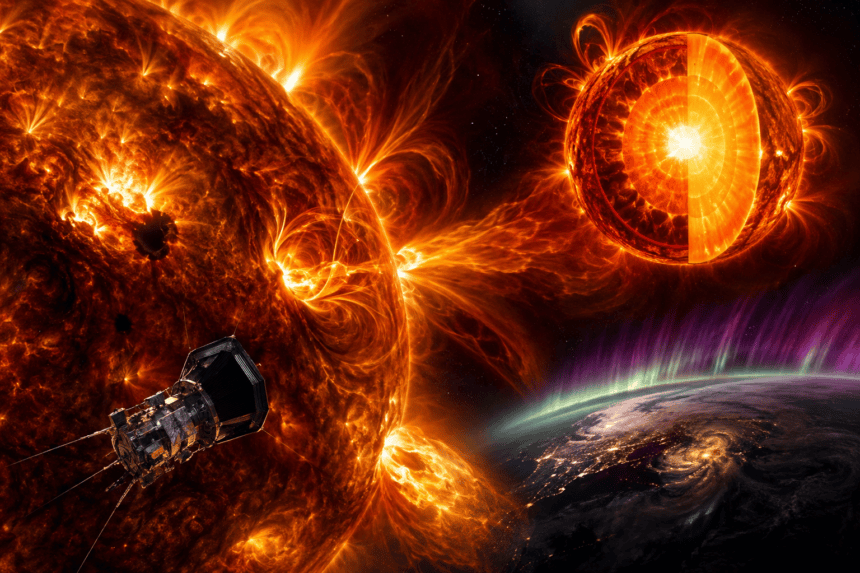
Scientists have revealed new discoveries about the Sun’s powerful activity, providing fresh insights into the dynamic processes that drive solar flares, sunspots, and massive eruptions of charged particles into space. The latest research is helping astronomers better understand how the Sun’s behavior influences the Solar System and affects Earth.
Using observations from advanced solar observatories and space missions, researchers analyzed the Sun’s magnetic fields, plasma flows, and surface activity. The findings reveal new details about the mechanisms behind powerful solar storms and how they evolve over time.
One of the study’s main focuses is the 11-year solar cycle, during which the Sun alternates between periods of low and high activity. Scientists found that changes in the Sun’s magnetic field play a crucial role in triggering solar flares and coronal mass ejections (CMEs)—powerful explosions that release billions of tons of charged particles into space.
Researchers also observed that intense solar activity can disrupt satellite communications, GPS systems, radio signals, and power grids on Earth. While Earth’s magnetic field protects the planet from most harmful solar radiation, particularly strong solar storms can still affect modern technology and increase the visibility of spectacular auroras near the polar regions.
The study provides valuable insights into how energy moves through the Sun’s outer atmosphere, known as the corona, which reaches temperatures of millions of degrees despite being farther from the Sun’s core. Scientists continue to investigate this long-standing mystery.
Experts say understanding solar activity is essential for improving space weather forecasting, helping governments and space agencies protect astronauts, satellites, and critical infrastructure from the effects of powerful solar storms.
Future missions and next-generation solar telescopes are expected to reveal even more about the Sun’s magnetic activity, internal structure, and its influence on planets throughout the Solar System.