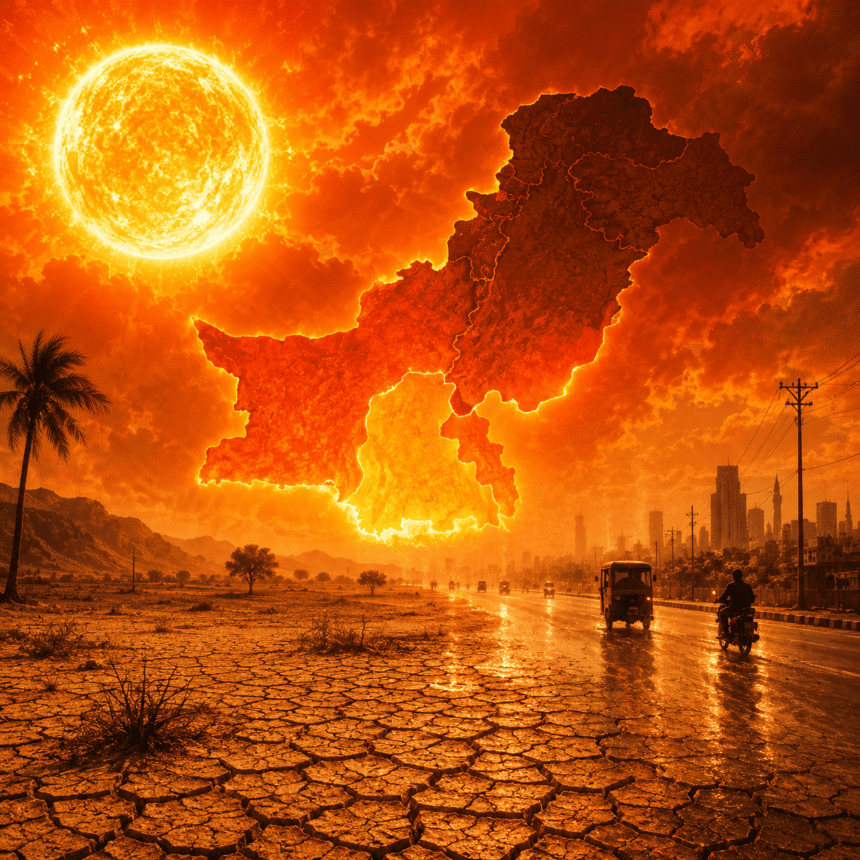
The mercury surged past 45°C across Sindh, Balochistan, and southern Punjab today, leaving millions to endure a relentless heatwave that shows no signs of breaking. Hospitals in Karachi, Hyderabad, and Jacobabad report a spike in heatstroke cases, while the power grid struggles to keep pace with the desperate demand for electricity.
The Pakistan Meteorological Department (PMD) issued a red alert, warning that the extreme heat will persist for at least another 72 hours. While coastal areas are seeing slightly lower readings, the humidity is pushing the “feels-like” temperature well into the danger zone, making the air stifling for anyone outdoors.
In Jacobabad—often cited as one of the hottest cities on Earth—residents have retreated indoors, leaving streets deserted by mid-morning. Local administration has set up “heat relief centers” equipped with water stations and basic medical supplies, but the scale of the crisis is testing local resources.
“We are seeing a 30% increase in patients reporting dizziness, fainting, and severe dehydration,” said Dr. Tariq Mansoor, a senior physician at a public hospital in Hyderabad. He warned that the elderly and children are at the highest risk, urging families to avoid direct sun exposure between 11:00 AM and 4:00 PM.
The economic impact is mounting. Agricultural workers in southern Punjab have shifted their shifts to pre-dawn hours to avoid the midday sun, slowing the harvest cycle. Meanwhile, urban centers are suffering from unannounced power outages, a recurring failure that turns homes into ovens during the peak heat.
The provincial governments have directed schools to adjust their timings, but critics argue these measures are reactive rather than preventative. With the climate changing, the frequency of these extreme events is rising, yet the infrastructure to shield the public remains largely unchanged from a decade ago.