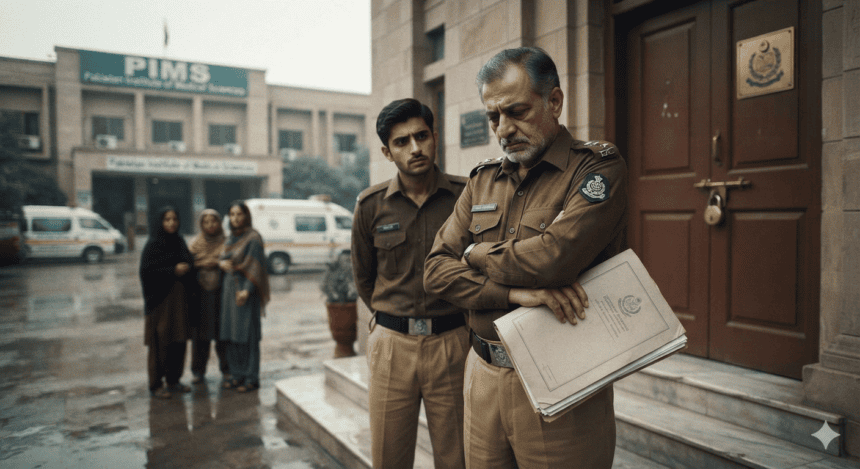
Islamabad police remain in a holding pattern regarding the registration of a First Information Report (FIR) into the recent patient deaths at the Pakistan Institute of Medical Sciences (PIMS). Despite mounting pressure from grieving families and public outcry, investigators say they are waiting for formal directives from the federal government before moving forward with criminal proceedings.
The delay centers on a procedural stalemate. While families of the deceased have submitted formal complaints alleging medical negligence and systemic failure, police officials insist that an internal inquiry by the Ministry of National Health Services must conclude first. This approach has left families in limbo, forcing them to protest outside the hospital gates while the facility continues its routine operations.
“We have received the applications,” a senior police official said on condition of anonymity, as he is not authorized to speak to the media. “But the nature of the allegations involves clinical protocols. We need the government to greenlight the investigation to avoid legal complications later.”
For the families, this is a clear attempt to shield the hospital administration. Critics argue that the reliance on government-led inquiries—which often lack transparency—is a tactic to dilute accountability. Instead of an independent police investigation, the focus remains on internal committees that rarely produce findings leading to prosecution.
PIMS, the capital’s largest tertiary care hospital, has faced recurring criticism over the last six months regarding staff shortages, broken diagnostic equipment, and a lack of essential medicines. The latest deaths have reignited these concerns, with patient rights advocates pointing to a “culture of impunity” where internal probes serve more as public relations exercises than mechanisms for justice.
The Ministry of Health has promised a “transparent review,” yet they have not provided a timeline for when that report will be made public or whether it will be shared with the police.
Without an FIR, the legal path for the families remains blocked. Until the government breaks its silence, the question of whether these deaths were preventable remains trapped in bureaucratic red tape, leaving the victims’ families with no clear path to justice.