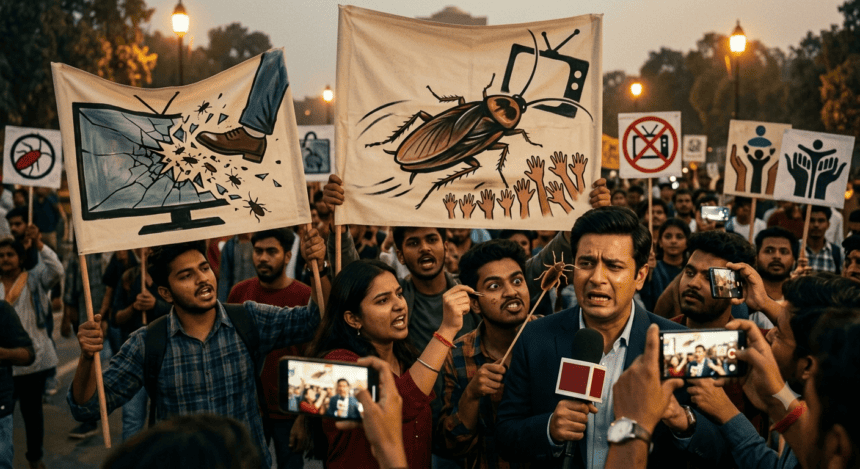
Journalists covering the protest outside the Press Club of India in Delhi faced an unexpected adversary Tuesday. As reporters from mainstream television networks attempted to broadcast live, activists dumped bags of cockroaches onto their camera setups and equipment.
The stunt—captured in viral clips—forced crews to scramble as the insects swarmed over tripods and microphones. Protesters chanted slogans accusing the networks of spreading “filth” and functioning as “Godi Media,” a derogatory term implying the outlets act as lapdogs to the ruling government.
Security personnel and police eventually intervened, clearing the protesters from the immediate vicinity. While no injuries were reported, the incident stalled live feeds for nearly twenty minutes.
The term “Godi Media” has become a rallying cry for critics who argue that major Indian news channels have abandoned objective reporting in favor of state-aligned narratives. Tuesday’s protest was not an isolated outburst; it reflects a deepening chasm between the public and the mainstream press. Critics claim these networks prioritize sensationalism over accountability, often ignoring economic hardships or civil unrest to focus on divisive cultural debates.
For the journalists on the ground, the encounter marks a shift in the nature of public hostility. While verbal heckling has become a common occupational hazard for TV crews, the use of live insects represents a calculated attempt to humiliate reporters while filming.
The Press Club of India has yet to issue a formal statement condemning the act, though individual journalists and media unions have expressed concern over the safety of field crews.
For the networks, the damage is more than just a ruined broadcast. The viral nature of the footage—shared widely on X and Instagram—has invited more mockery than sympathy. As the clips circulate, the debate remains: have these reporters lost their ability to cover the streets without becoming the story themselves?