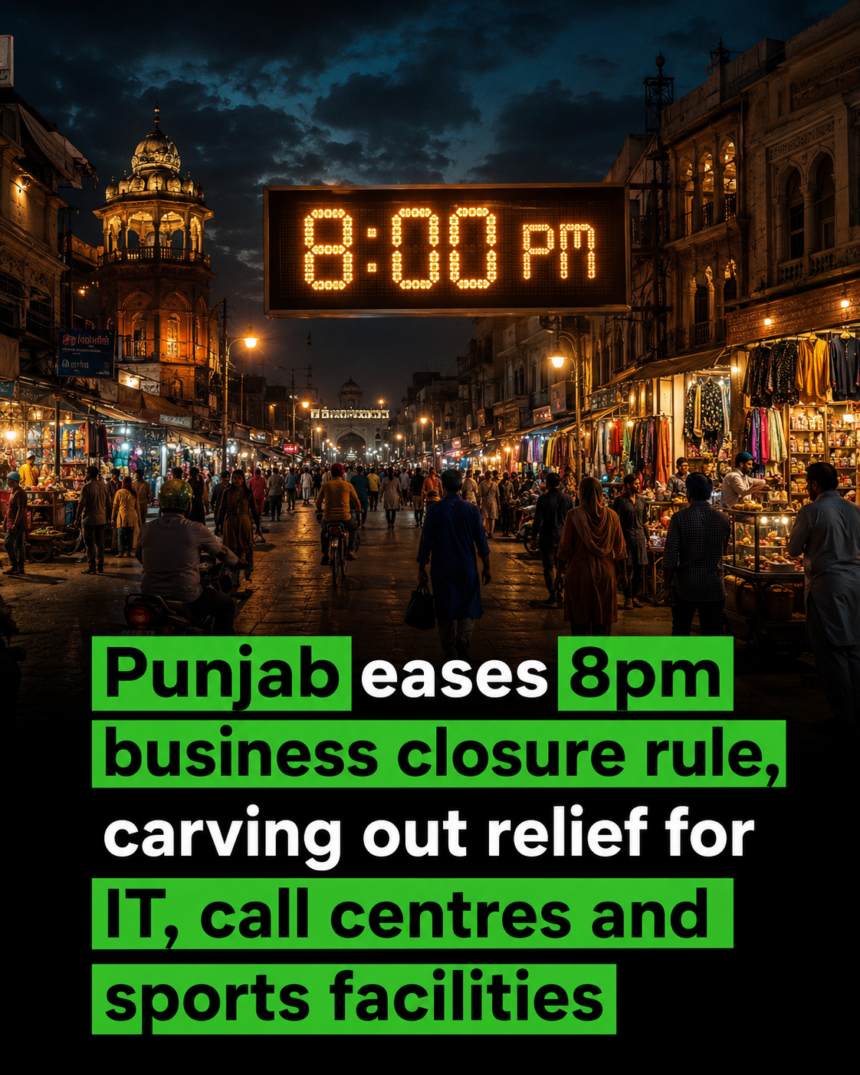
Punjab has begun softening its strict 8pm business shutdown policy, creating room for sectors the government appears unwilling to squeeze under a one-size-fits-all energy-saving regime. The shift matters most for IT-related firms, call centres, BPO operators and sports facilities, all of which had argued that early closures were hurting productivity, service delivery and, in some cases, livelihoods.
The original order, rolled out in early April, was part of a broader federal and provincial energy-conservation push. Markets, shops and shopping malls in Punjab were told to shut by 8pm, while hotels, restaurants and food outlets were allowed to stay open until 10pm. Pharmacies, hospitals, medical stores, petrol pumps, CNG stations, tandoors, bakeries and milk shops were among the early exemptions.
Now, though, the policy is looking more selective than sweeping.
The clearest relief has come for the digital services side of the economy. Reporting in recent weeks shows the federal government moved to fully exempt call centres and business process outsourcing firms from commercial timing restrictions, allowing round-the-clock operations and directing the Pakistan Software Export Board to help firms facing implementation problems. That exemption is especially significant for a sector that works across time zones and depends on overnight operations for overseas clients.
That logic extends naturally to IT-linked businesses more broadly. Punjab has faced this question before: technology firms have long argued that rigid market-style timings don’t fit an industry built around remote clients, service windows abroad and non-traditional office hours. Even where the language of official relaxations has varied from one report to another, the policy direction is fairly clear now — digital export-oriented operations are being treated differently from ordinary retail.
Sports facilities have become another flashpoint in the debate. In Islamabad, authorities explicitly brought sports facilities and clubs under timing restrictions in mid-April, ordering them to close by 8pm. In Punjab, pressure has gone the other way: athletes and fitness stakeholders have publicly urged the provincial government to extend gym and sports-facility hours, arguing that evening access is essential for people who work standard office jobs and can only train later in the day.
That pushback has fed into a wider criticism of the closure regime. Traders in Punjab had already complained about uneven enforcement and confusion over who exactly was covered, with business groups calling for uniform rules across commercial zones, including elite and cantonment areas. What began as an austerity and energy-saving measure has gradually turned into a balancing act between conservation on paper and economic reality on the ground.
The government’s broader justification hasn’t changed much. Officials have framed the curbs as part of a response to economic strain and power-related pressures, presenting early market closures as a way to cut electricity use and signal fiscal discipline. But the exemptions tell their own story. Essential services were spared from day one. Export-facing digital firms were later protected. And sectors with strong public-use arguments, like sports and fitness, have continued pressing for room to operate beyond the original cut-off.
So the headline here isn’t simply that Punjab imposed an 8pm rule. It’s that the rule is already evolving, and pretty quickly. The province is still holding on to the language of conservation, but in practice it is carving out a hierarchy: retail closes early, essentials stay open, and industries seen as strategic, export-driven or socially important are being nudged outside the hard edges of the policy.
For businesses, the immediate question is whether this gradual easing stays limited to a few sectors or opens the door to a broader rethink. For now, Punjab’s message seems mixed but readable enough: the 8pm rule remains in place, just not for everyone.