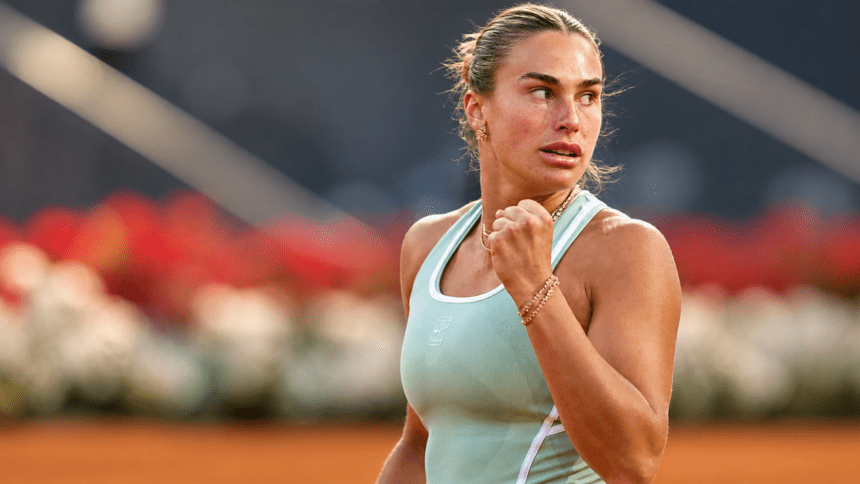
Aryna Sabalenka has taken the French Open prize-money dispute into sharper territory, saying players could eventually boycott a Grand Slam if they feel they are not being paid fairly. The world No. 1 made the remarks in Rome on May 5, 2026, as frustration grew over Roland Garros’ newly announced prize fund and the broader question of how much of Grand Slam revenue actually reaches players.
The immediate trigger is the 2026 French Open purse, set at €61.7 million, up 9.5% from last year. Singles champions are due to receive €2.8 million each. On paper, that is a substantial increase. But many leading players argue the bigger issue is not the headline number itself, it is the share of tournament revenue they receive compared with what they believe is a fairer split.
Sabalenka’s comments did not come out of nowhere. A group of top ATP and WTA players had already renewed pressure on the Grand Slams, voicing what reports described as “deep disappointment” over Roland Garros’ 2026 prize money and over wider concerns around player welfare and consultation. That has turned what might have been a routine annual complaint into something more serious, with top names speaking more openly and more publicly than before.
Coco Gauff has also backed the idea that players may need to act collectively if negotiations go nowhere. Other players appear more cautious, signaling support for better compensation and stronger dialogue without fully embracing a boycott. So, for now, this is more warning shot than fixed plan. Still, it is not empty noise either. The fact that leading players are even using the word “boycott” tells you how tense the conversation has become.
At the center of the dispute is a long-running complaint in tennis: the stars who fill stadiums and drive broadcast value believe they receive too little relative to the money the majors generate. Recent reporting says players are pushing for a revenue share closer to what they receive at combined ATP and WTA events, with some estimates placing the current Grand Slam range at roughly 15% to 22% of revenue depending on the event and year.
Roland Garros, for its part, can point to the increase in this year’s purse and to equal prize money for men and women in singles. Organizers have framed the 2026 package as a meaningful rise, including boosts in several categories beyond the champions’ checks. That, though, has not calmed the top end of the locker room, where the argument has shifted from annual increments to structural fairness.
What happens next may matter beyond Paris. Wimbledon’s prize money has not yet been announced, and the same pressure is likely to follow the other majors if players feel their concerns are being brushed aside. There is no formal boycott on the table yet, but the message from Rome was unmistakable: some of the sport’s biggest names are no longer content to grumble quietly and move on.