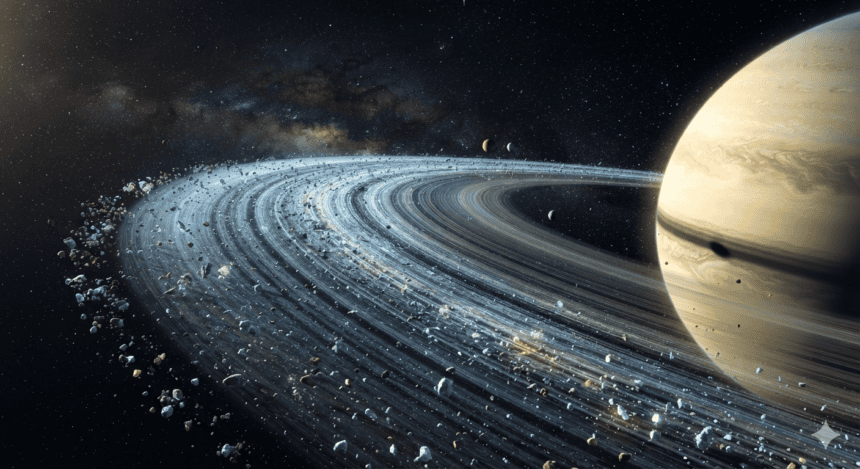
Scientists have uncovered new secrets about Saturn and its iconic ring system, offering fresh insights into how the planet and its spectacular rings formed, evolved, and continue to change over time. The latest research is helping astronomers better understand one of the Solar System’s most recognizable worlds.
Using observations from powerful space telescopes, ground-based observatories, and data collected by past missions such as Cassini, researchers analyzed the structure, composition, and movement of Saturn’s rings. The findings reveal new details about the interaction between the rings, Saturn’s moons, and the planet’s powerful gravitational field.
Saturn’s rings are made up of billions of particles of ice, rock, and dust, ranging in size from tiny grains to chunks several meters across. Scientists believe the rings may have formed from the remnants of shattered moons or comets that ventured too close to the planet and were torn apart by Saturn’s immense gravity.
The new study also sheds light on a phenomenon known as “ring rain,” in which particles from the rings gradually fall into Saturn’s atmosphere under the influence of the planet’s magnetic field. Researchers say this process suggests that the rings are slowly disappearing and may not exist forever.
Astronomers also observed subtle changes in the brightness and density of different ring sections, providing valuable clues about ongoing collisions, the influence of nearby moons, and the dynamic processes shaping the ring system.
Scientists emphasize that Saturn serves as a natural laboratory for studying planetary formation and the behavior of disks of material around celestial bodies. These findings may also improve our understanding of how planets and planetary systems form around distant stars.
Experts believe future space missions and next-generation telescopes will reveal even more about Saturn’s atmosphere, magnetic field, moons, and magnificent rings, bringing humanity closer to understanding the evolution of the Solar System.