Scientists are continuing to explore the theoretical possibility of parallel universes, a concept that has fascinated physicists and cosmologists for decades. While there is currently no direct evidence that parallel universes exist, new theoretical research is helping scientists better understand whether our universe could be just one of many.
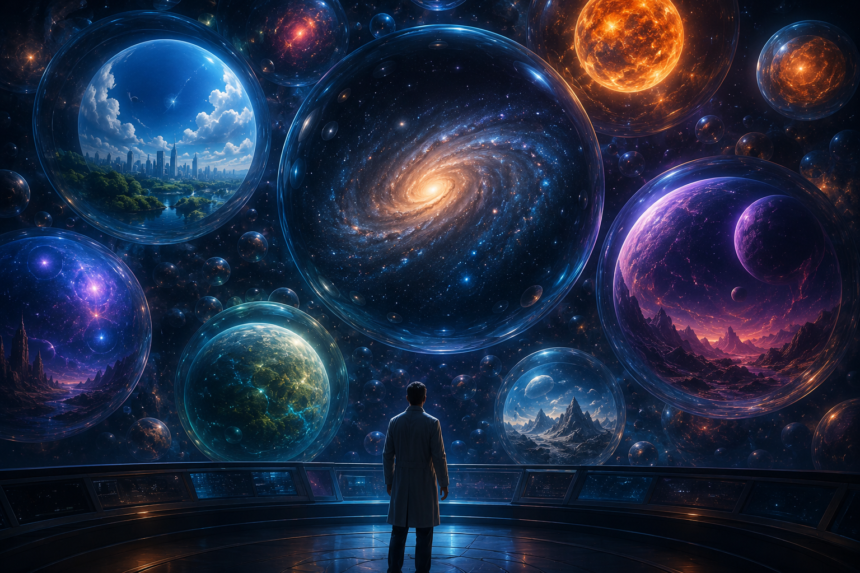
The idea of parallel universes, often referred to as the multiverse theory, suggests that countless universes may exist alongside our own, each with its own physical laws, particles, and even different versions of reality. Several branches of modern physics—including quantum mechanics, cosmic inflation, and string theory—have inspired scientific models that allow for the possibility of multiple universes.
Researchers are using advanced mathematical models, computer simulations, and observations of the early universe to investigate whether traces of other universes could be hidden in the cosmic microwave background (CMB)—the faint radiation left over from the Big Bang.
Some physicists believe that if another universe collided with ours in the distant past, it might have left subtle patterns or temperature variations in the CMB. However, no observations to date have provided conclusive proof of such an event.
Scientists emphasize that the multiverse remains a theoretical hypothesis, not an established scientific fact. Current technology cannot directly observe or travel to another universe, and much of the research focuses on testing whether existing theories make predictions that can eventually be verified.
Experts say studying the possibility of parallel universes could deepen our understanding of gravity, quantum physics, dark matter, dark energy, and the origins of the cosmos. Even if the multiverse is never proven, the research continues to push the boundaries of modern physics and expand humanity’s understanding of reality.
Future observatories, more powerful telescopes, and advances in theoretical physics may provide new clues about whether our universe is unique—or simply one among countless others.