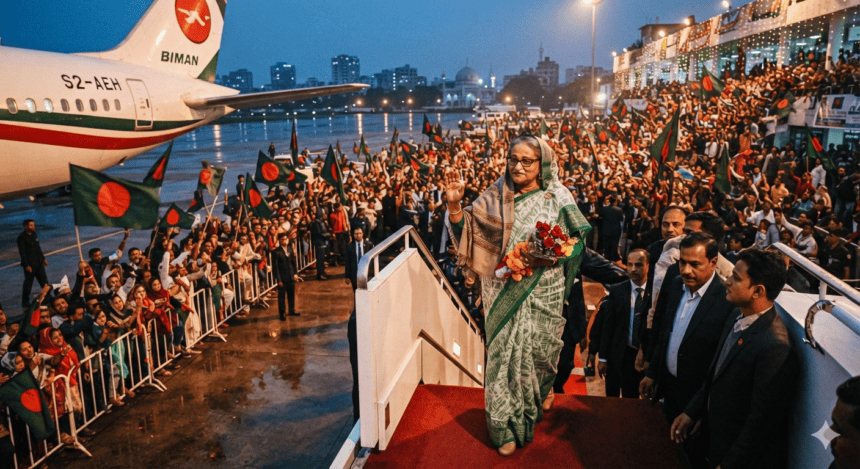
Sheikh Hasina, the former prime minister of Bangladesh, has announced plans to return to the country this December. The statement comes four months after she fled to India amid a violent uprising that ended her 15-year hold on power.
Hasina’s return was relayed by her son, Sajeeb Wazed Joy, during an interview with the Voice of America. He confirmed that his mother intends to resume political activity once the current interim government, led by Nobel laureate Muhammad Yunus, concludes its tenure.
The announcement arrives at a volatile moment for the Awami League. Since Hasina’s departure on August 5, the party has faced a massive leadership vacuum. Hundreds of mid-to-low-level officials have been arrested, while senior figures remain in hiding or behind bars to avoid prosecution for their roles in the crackdown against student protesters earlier this summer.
Her return would be a direct challenge to the interim administration. The Yunus-led government is currently working to stabilize the economy and reform the electoral process, aiming to hold general elections once the political landscape is deemed “fair.” The prospect of Hasina’s homecoming threatens to derail these efforts, potentially reigniting the deep-seated polarization that defined her final years in office.
For the interim government, the challenge is immediate. They must decide how to handle a potential returnee who faces dozens of murder cases and charges of crimes against humanity. The International Crimes Tribunal in Dhaka has already issued an arrest warrant for her, leaving the administration with a binary choice: allow her to face the courts or risk a diplomatic standoff with India, where she remains in exile.
Many of her supporters see the December timeline as a rallying cry. With the Awami League’s grassroots base currently disorganized, her physical presence could serve as a focal point for a party desperate to rebrand itself after the August collapse.
Critics, however, view the timing as a calculated provocation. Student leaders, who spearheaded the protests that toppled her government, have already declared that there is no place for her in the country’s future.
Whether she lands in Dhaka or remains in New Delhi, her intentions have shifted the political calculus. The interim government now faces a deadline of its own: demonstrate tangible progress in the reform agenda before the former leader returns to contest the narrative of her own downfall.