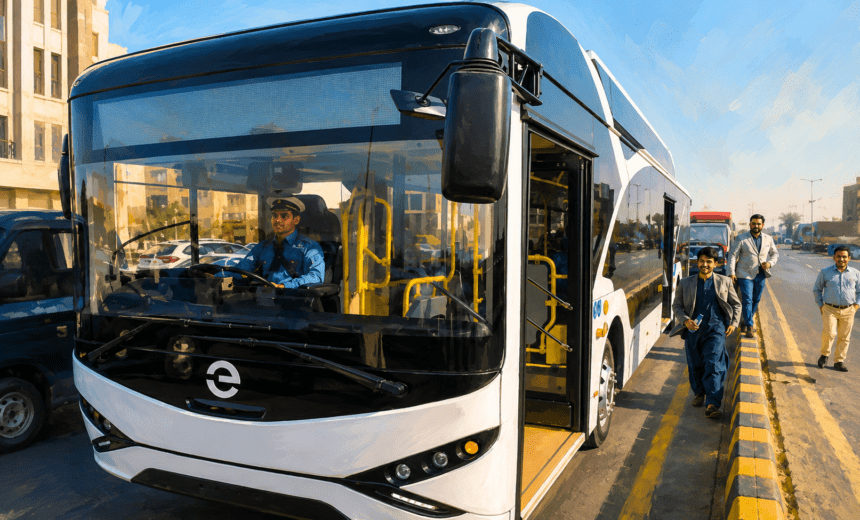
KARACHI: The Sindh government has approved the procurement of 500 new electric buses, a move officials say will widen public transport coverage in Karachi and other urban centres while cutting pressure on commuters who still depend heavily on private vans, rickshaws and motorcycles.
Sindh Senior Minister and Transport Minister Sharjeel Inam Memon announced the decision during a Sindh Assembly session, saying the buses would be brought in under a public-private partnership model as part of the province’s broader push to modernise mass transit.
The announcement came after MQM-P lawmaker Naseer Ahmed raised concerns over the shortage of public transport in Karachi’s Manghopir area. Memon, responding on the floor of the House, said the government was expanding the network and that new routes would be introduced in several underserved parts of the city.
According to details reported from the Assembly proceedings, the new EV buses are expected to serve routes linked with Ittehad Town, Banaras Colony, Liaquatabad, Jahangir Road and Cantt Station. Additional services are also planned for Orangi Ghaziabad, Iqbal Market, Walika, Nazimabad No. 2, Ayesha Manzil and Zahoor Chowk — areas where daily commuters have long complained about thin, unreliable or overcrowded transport options.
It’s not just a Karachi story, though Karachi remains the biggest pressure point. The province’s transport network has also been expanding into other cities and towns, with officials previously pointing to services in Tando Allahyar, Khairpur and Rohri, along with newer routes inside Karachi such as Gulshan-e-Maymar to Tower.
The project appears to align with the Sindh government’s People’s Green Transport Project, which envisages deploying 500 electric buses — 450 in Karachi and 50 in Hyderabad — along with charging infrastructure, depots, transit shelters and an integrated intelligent transport system. The official project description says the assets will eventually be transferred to the Sindh government after the concession term ends.
For Karachi, the timing matters. The city’s transport crisis has been building for years, with millions of residents relying on a patchwork system of private minibuses, ride-hailing, motorcycles and informal services. For many working-class neighborhoods on the city’s western and northern edges, a clean, regular bus service isn’t a luxury — it’s the difference between reaching work on time and spending hours negotiating broken routes.
The planned EV fleet also gives the government an environmental argument. Electric buses can help reduce tailpipe emissions in one of Pakistan’s most congested cities, though the real test will be less glamorous: whether charging stations, depots, maintenance contracts, fare systems and route discipline are ready before the buses arrive.
Transport projects in Karachi often make big promises. Commuters, frankly, have heard plenty of them. This one will be judged by something simple: whether buses actually show up, on time, in places like Manghopir, Orangi, Banaras and Nazimabad — not just on launch day, but every day after that.