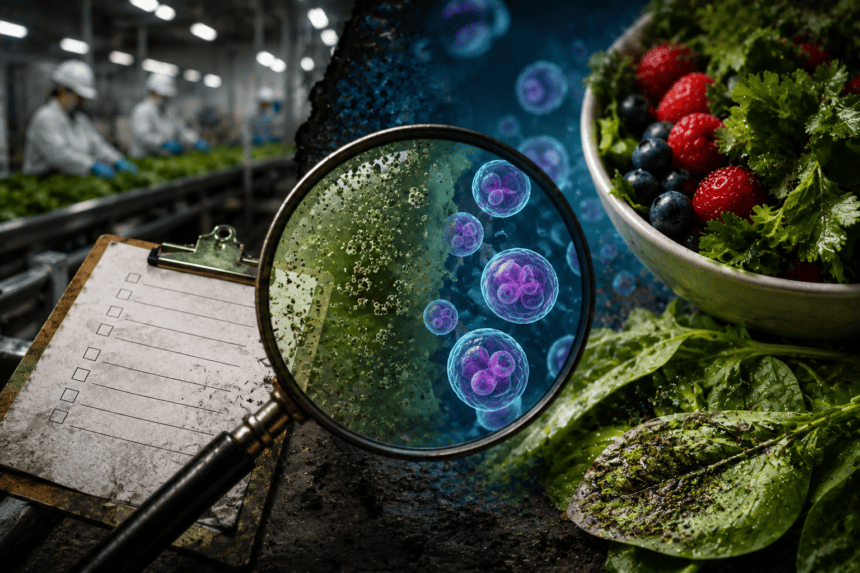
The U.S. food safety system is built to catch E. coli and Salmonella, but it is failing against *Cyclospora cayetanensis*. Over the last decade, this microscopic parasite has repeatedly slipped through supply chains, sickening thousands and leaving health officials scrambling to trace the source of outbreaks that often vanish before they can be pinned down.
*Cyclospora* is different. Unlike bacteria that multiply rapidly in food, this parasite doesn’t need to grow on produce to be infectious. It hitches a ride on fresh herbs and leafy greens, surviving washing, sanitizing, and refrigeration. By the time a cluster of illnesses hits emergency rooms, the contaminated batch has long since been consumed.
The failure lies in the latency of the system. Detection of an outbreak relies on a slow, multi-step process: a patient visits a doctor, a stool sample is sent to a lab, and the results are eventually reported to the CDC. This process takes weeks. By then, the original produce has cleared the shelves, making the “traceback” process—the cornerstone of FDA food safety—nearly impossible.
“We are chasing ghosts,” said one food safety consultant familiar with FDA outbreak investigations. “By the time we identify a cluster, the retail trail is cold. We can’t recall what’s already in the trash.”
Traceability gaps worsen the problem. The U.S. food system relies on “one-up, one-down” record-keeping, meaning wholesalers and retailers only track where they got a product and where it went next. When produce is aggregated from dozens of small farms into a single processing facility, the origin is obscured. A bag of salad can contain leaves from five different farms, but current labeling laws rarely require that level of transparency.
Imports are another blind spot. While the FDA has implemented the Foreign Supplier Verification Program, the sheer volume of fresh produce entering the U.S. from countries with *Cyclospora* endemicity—such as Mexico and parts of Central America—outstrips inspection capacity. Inspectors can’t test for a parasite that is notoriously difficult to isolate in environmental samples.
The human toll is significant. Victims often suffer from explosive diarrhea, severe fatigue, and weight loss that can persist for weeks or months if not treated with specific antibiotics. Many patients go undiagnosed, as standard stool cultures don’t look for *Cyclospora* unless a physician specifically requests a “parasite exam.”
Technological solutions, such as blockchain-based traceability and advanced genomic sequencing, are in the works. Yet, these tools are expensive and voluntary. As long as the food industry prioritizes speed and cost over granular, farm-level transparency, *Cyclospora* will continue to find its way from the fields to the dinner table.
For now, the burden of safety remains on the consumer, who is left to guess whether their fresh cilantro or imported berries are carrying a microscopic hitchhiker.