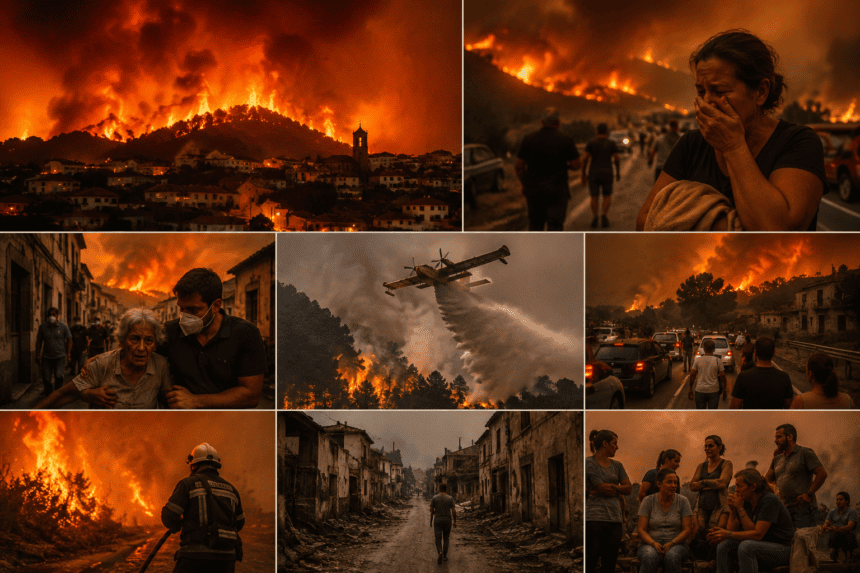
The fire didn’t sound like a crackling campfire. It sounded like a freight train, according to those who fled the mountain towns of eastern Spain this week. As temperatures climbed and winds whipped through tinder-dry forests, residents had minutes—sometimes seconds—to grab what they could and drive toward the coast.
For Maria Gomez, a lifelong resident of a village near Valencia, the warning came not from an alarm, but from the smell of burning pine that suddenly choked the air. By the time she reached her driveway, the horizon had turned a bruised, electric orange. She didn’t pack a bag. She loaded her two dogs into the backseat and drove through a corridor of embers that she says felt like “driving through the mouth of a furnace.”
The intensity of these blazes has caught even seasoned emergency crews off guard. Drought conditions have turned the region’s scrubland into fuel, leaving firebreaks ineffective against the speed of the advancing wall of heat. Authorities confirmed that at least three towns were evacuated under emergency orders, with local police going door-to-door to ensure no one remained trapped inside their homes.
“The heat was so intense it shattered the windows of the car in front of me,” said Javier Ruiz, who fled his home late Tuesday evening. He spent the night in a municipal sports hall, one of dozens of makeshift shelters established for the displaced. “You don’t think about your belongings. You just think about the road ahead.”
Meteorologists point to a prolonged heatwave and shifting wind patterns as the primary drivers of the erratic behavior of these fires. While water-dropping aircraft have been deployed, the smoke density has hindered aerial operations, forcing ground crews to fight the flames in rugged, inaccessible terrain.
Government officials confirmed that while the most immediate threat to residential areas has been contained, the danger remains acute. Thousands of hectares have already been scorched, and with the wind expected to shift again by dawn, the battle to protect surrounding infrastructure is far from over.
For those who lost their homes, the reality is only just setting in. They are now waiting for the smoke to clear, watching the ridgelines from behind police cordons, and wondering if the landscape they grew up in will ever look the same.