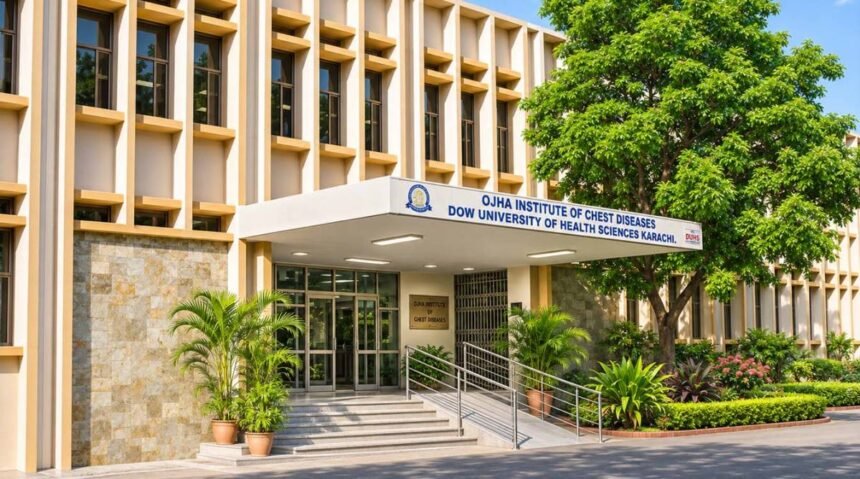
In a major achievement for Pakistan’s healthcare and medical research sectors, the World Health Organization (WHO) has designated the Ojha Institute of Chest Diseases (OICD), operating under Dow University of Health Sciences (DUHS), Karachi, as a WHO Collaborating Centre for Chest Diseases.
The international recognition is expected to strengthen Pakistan’s contribution to tuberculosis (TB) research, respiratory healthcare, medical education and scientific innovation.
Under the WHO collaboration framework, the institute will undertake an agreed technical work plan focusing primarily on tuberculosis research, particularly the application of artificial intelligence (AI) to improve diagnostic services.
The initiative will also support specialised medical training, professional development and efforts to strengthen healthcare capacity across the region.
According to university officials, the collaboration will help enhance diagnostic capabilities, promote scientific innovation and support more effective interventions against tuberculosis and other respiratory diseases.
A Historic Institution with More Than Eight Decades of Service
Established in 1939 as a sanatorium for tuberculosis patients, the Ojha Institute became part of Dow University of Health Sciences in December 2003.
Over the years, it has developed into a specialised healthcare and research institution serving patients from Sindh and other parts of Pakistan.
The institute currently operates a 270-bed specialised hospital, six affiliated chest clinics, a provincial reference laboratory and a state-of-the-art negative-pressure Pulmonary Tuberculosis Intensive Care Unit (ICU).
It also offers accredited postgraduate training programmes in chest diseases, contributing to the development of skilled medical professionals in respiratory healthcare.
Strengthening Pakistan’s Role in Global Health Research
The WHO designation is expected to create new opportunities for international academic partnerships, collaborative scientific research and advanced medical training.
The use of artificial intelligence in tuberculosis diagnostics is particularly significant, as emerging technologies can support the identification of suspected TB cases and improve screening services.
The institute’s new international status will provide a platform to strengthen research activities and contribute to regional efforts aimed at controlling tuberculosis and improving respiratory healthcare.
The achievement marks an important milestone for Dow University of Health Sciences and Pakistan’s medical research community, highlighting the country’s growing contribution to international healthcare cooperation.