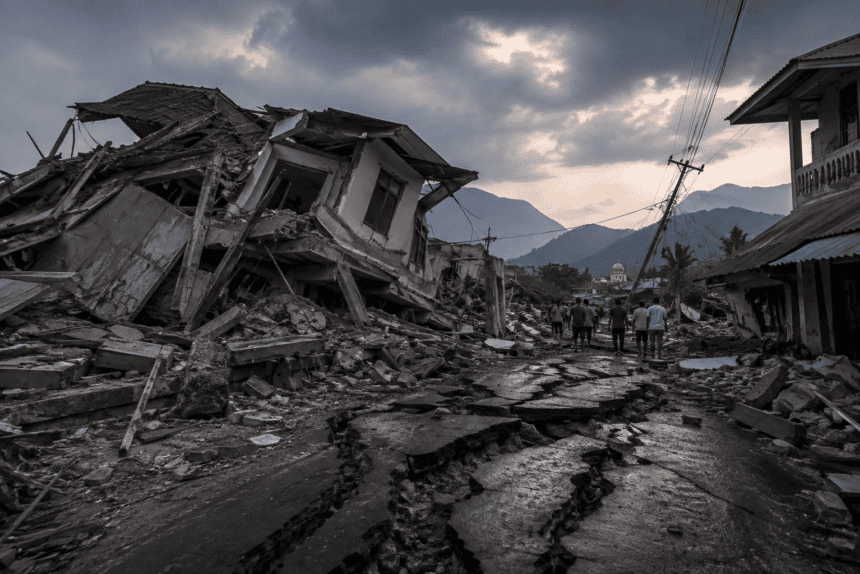
A massive 7.7-magnitude earthquake struck Indonesia early Tuesday, leaving at least 47 people dead and hundreds injured. The quake hit at 4:12 a.m. local time, centered 120 kilometers off the coast of the Maluku Islands at a depth of 10 kilometers.
Rescue crews are currently digging through the rubble of flattened homes and collapsed schools in the worst-hit coastal districts. Hospitals in the region are overwhelmed. Doctors are treating victims in parking lots and makeshift tents because the main structures suffered severe structural damage.
“The ground didn’t just shake; it rolled,” said local resident Ahmad Yusuf, who managed to escape his home seconds before the roof caved in. “We didn’t have time to grab anything. We just ran.”
The tremor triggered a localized tsunami warning, sending thousands of residents fleeing to higher ground in a frantic pre-dawn evacuation. While the warning was lifted three hours later, the psychological impact has left coastal communities paralyzed.
Infrastructure damage is extensive. Power grids are down across the province, complicating search efforts as night falls. Local authorities have requested emergency supplies, including heavy machinery, portable medical kits, and clean water, but blocked roads are slowing the arrival of aid.
The Indonesian Agency for Meteorology, Climatology and Geophysics confirmed the quake was followed by a series of at least 15 aftershocks, some registering above 5.0 in magnitude. These tremors have hampered the work of search-and-rescue teams, forcing them to pause operations repeatedly for safety.
Indonesia sits squarely on the “Pacific Ring of Fire,” an area prone to seismic instability. This latest disaster hits a region still recovering from a series of smaller, damaging tremors earlier this year.
As the sun sets, the focus shifts entirely to the missing. With communication lines fractured and rural villages cut off by landslides, officials warn that the death toll will almost certainly climb before morning.