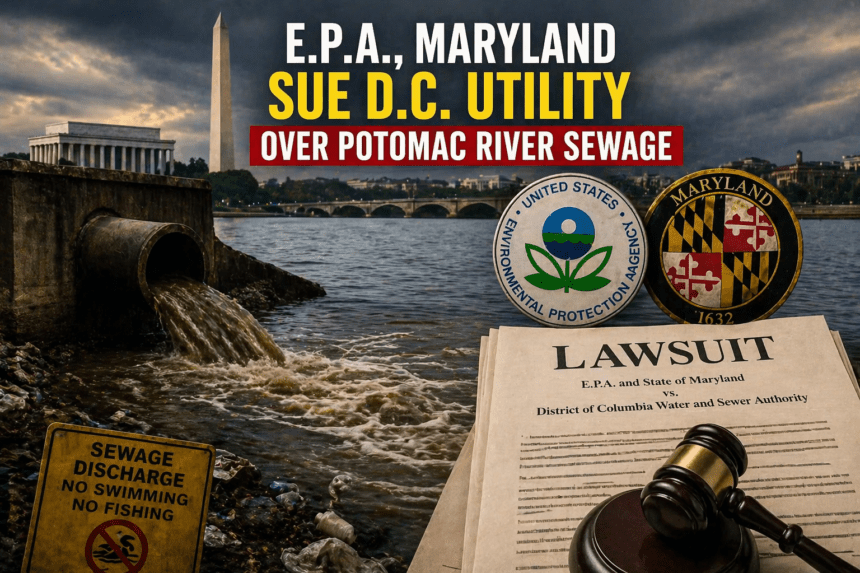
The federal government and the state of Maryland have filed separate lawsuits against DC Water, turning January’s Potomac River sewage disaster into a major legal fight over who knew what, and when. At the center of both cases is the Potomac Interceptor, a 72-inch sewer line that collapsed on January 19 in Montgomery County, Maryland, sending more than 240 million gallons of raw sewage into the river system.
The Justice Department, acting on behalf of the EPA, says the collapse led to violations of the Clean Water Act and is seeking penalties and court-ordered corrective action. Maryland’s case goes a step further on the state side, asking for cleanup and restoration costs and accusing DC Water of failing to address known deterioration in time to prevent the spill. Maryland officials have argued the damage did not stop at the pipe break itself, saying the contamination affected public waters and nearby communities in a way that now demands accountability.
What makes the lawsuits especially serious is the allegation that this was not some sudden, unforeseeable failure. Federal and local reports say the pipeline, built in the 1960s, had shown severe corrosion for years. According to the federal complaint and subsequent coverage, inspectors had identified major structural problems well before the rupture, and prosecutors argue DC Water had at least eight years of warning that parts of the line needed urgent attention.
The Potomac Interceptor is not a minor piece of infrastructure. EPA says it carries up to 60 million gallons of wastewater a day from parts of Maryland and Virginia to DC Water’s Blue Plains treatment plant. When it failed, the spill quickly became one of the region’s biggest environmental emergencies, drawing in EPA, FEMA, the Army Corps of Engineers and other agencies as response efforts expanded.
DC Water, for its part, has pushed back against the idea that it ignored the risk. The utility says it had already been inspecting the line, had begun rehabilitation work on a nearby section before the collapse, and moved aggressively after the failure to contain the overflow, repair the damaged pipe and start environmental restoration. It has also said no overflows had been reaching the river after February 8, that emergency repairs were completed in March, and that longer-term rehabilitation is still underway.
That response, though, may not be enough to blunt the broader political and legal fallout. The lawsuits land at a moment when aging water infrastructure is under sharper scrutiny nationwide, and this case is likely to become a test of how far regulators can go in holding public utilities responsible for failures tied to long-documented decay. Around Washington and along the Potomac, the immediate emergency may have eased. The argument over negligence, cleanup costs and long-term damage is only just beginning.