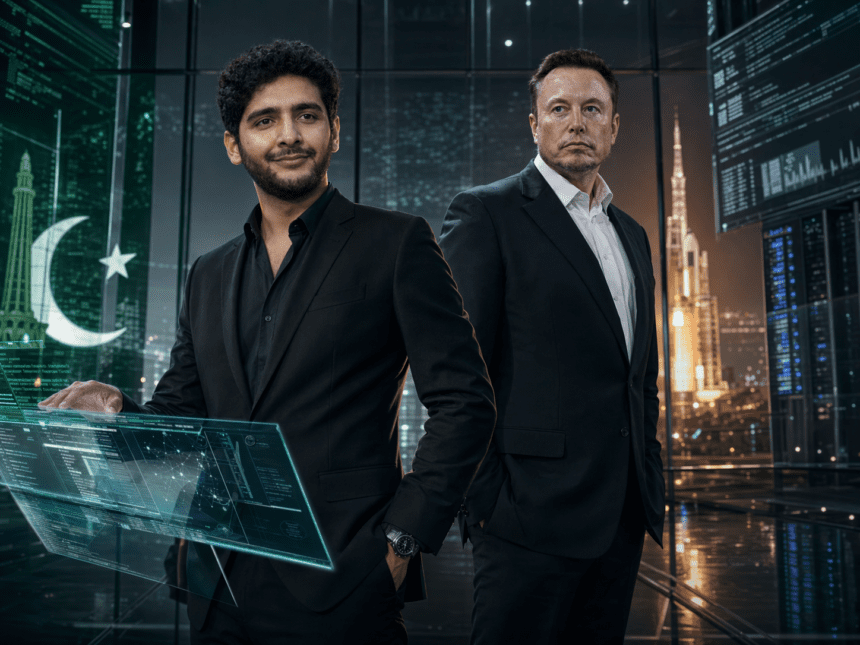
Elon Musk’s SpaceX has struck an unusual and very high-stakes agreement to buy AI coding startup Cursor for $60 billion later this year, a deal that instantly turned heads across Silicon Valley and, for many in Pakistan, brought fresh attention to Karachi-born co-founder Sualeh Asif. The company behind Cursor is Anysphere, a San Francisco-based startup, so the headline often circulating online needs a correction: this is not a Pakistani startup, but it is a company with a Pakistani-born founder at its core.
The structure of the arrangement is what makes it stand out. According to current reports, SpaceX says it now has the right to acquire Cursor for $60 billion in 2026, or, if a full takeover does not go ahead, it would instead pay $10 billion for the companies’ joint work. That is not a routine acquisition announcement. It is more like a strategic bet placed in public, and a very expensive one.
Cursor, in case you haven’t been following the AI coding boom minute by minute, is one of the biggest names in software tools built around generative AI. The product is widely used by programmers and has become one of the most talked-about tools in the rise of so-called “vibe coding”—the fast, conversational style of software creation where developers lean heavily on AI to draft, revise and explain code. Reuters coverage summarized by AP says Cursor has become especially popular among experienced engineers, which helps explain why it attracted such intense interest from major tech players.
That interest was not limited to Musk’s orbit. Reports say Microsoft had also explored buying Cursor, while TechCrunch reported that the startup had been on track to close a $2 billion fundraising round before SpaceX moved with its buyout option. In other words, this was not some obscure company suddenly getting lucky. Cursor was already deep in the center of the AI arms race.
For Pakistani readers, though, the strongest angle is Sualeh Asif. Local coverage has highlighted him as a Karachi-born co-founder whose rise is now being linked to one of the largest AI-related corporate moves of the year. Forbes’ current billionaire profile also reflects how sharply his standing has risen alongside Cursor’s valuation growth.
There is also a broader business story here, and it’s a big one. SpaceX, best known for rockets and satellites, appears to be pushing much harder into artificial intelligence as competition intensifies against OpenAI, Anthropic and other major players. AP’s report says Cursor will work with xAI’s Colossus data center in Memphis to expand model training capacity, which suggests this is not just about owning a hot startup. It is about compute, infrastructure, talent and speed. Put simply, Musk seems to want a stronger hand in AI coding before the market gets even more crowded.
The timing matters too. Several reports say the move comes as SpaceX prepares for a possible public-market debut later this year. That adds another layer of pressure and intrigue. Buying, or even securing the right to buy, a company like Cursor gives investors a clearer signal about where SpaceX sees future growth: not only in launch systems and connectivity, but in AI tools that could shape how software itself is built.
Still, the headline making the rounds online needs to be handled carefully. Saying “SpaceX offers to buy Pakistani startup for $60 bln” is catchy, sure, but it blurs a key fact. Cursor is an American startup. What is true—and genuinely newsworthy—is that a Pakistani-born founder is central to one of the most valuable AI startup deals now under discussion. That distinction matters, especially in financial reporting.
For Pakistan’s tech community, the moment still lands hard. A founder with roots in Karachi is now tied to a company at the center of a reported $60 billion SpaceX transaction. That does not magically turn Cursor into a Pakistani startup. But it does underline something real: Pakistani talent is showing up, and in some cases leading, at the highest levels of global technology.