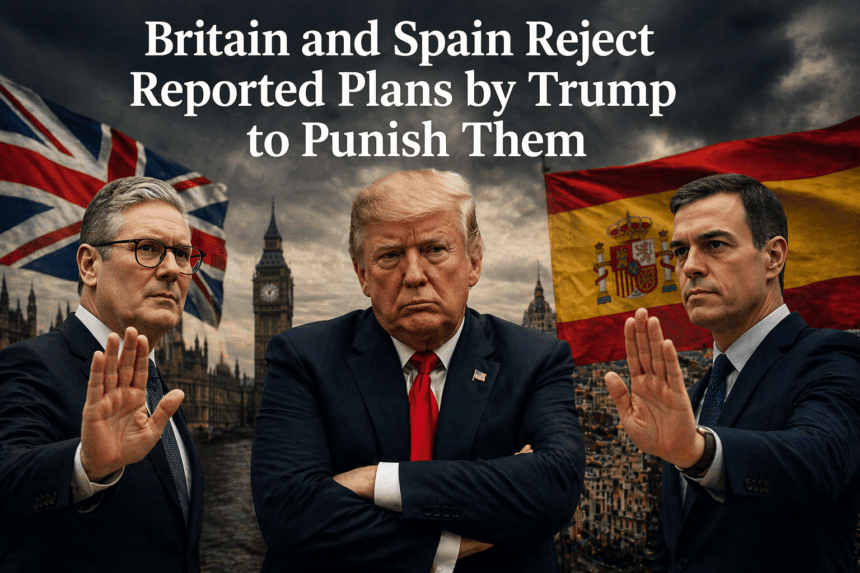
Britain and Spain have pushed back against reports that President Donald Trump is weighing punitive action against NATO allies he believes failed to support the United States during the Iran war, opening yet another front in an already raw dispute between Washington and key European capitals. Recent reporting says the options under discussion have ranged from troop relocations and diplomatic pressure to more politically loaded ideas aimed at countries seen inside the administration as unhelpful.
Spain’s response was clearer and more public than the two. Prime Minister Pedro Sánchez brushed aside the reports and said Spain acts within international law and in coordination with allies under those legal limits. Sources reported that Spain, along with Britain and France, denied U.S. forces access to bases or airspace for the conflict, citing concerns over the legality of U.S.-Israeli military action.
The broader anger inside the Trump camp appears to be real, even if not every floated idea is legally or politically workable. The Wall Street Journal reported that the administration has discussed punishing countries including Spain, Germany and Italy by shifting U.S. troops and military assets toward allies viewed as more supportive, such as Poland, Romania, Lithuania and Greece. That report framed the effort as part of a widening rupture between Washington and Europe over burden-sharing and the Iran conflict.
One of the most eye-catching claims in the reporting involved Spain and NATO itself. Sources said the Pentagon was rumored to be considering suspending Spain from the alliance, but noted that NATO’s founding treaty does not provide for expulsion or suspension of a member state. That makes the threat sound more like political signaling than a clean legal option.
Trump’s frustration with allies is not new, but the Iran war has sharpened it. According to the Journal, he has accused NATO countries of doing little or nothing to help the U.S. campaign, and NATO Secretary-General Mark Rutte has publicly acknowledged that Trump is “clearly disappointed” with a number of allies over their stance.
Spain, meanwhile, was already in Trump’s line of fire before these latest reports because of defense spending. At the NATO summit in June 2025, Sánchez secured an exemption from the alliance’s new 5% of GDP defense-spending benchmark, saying Spain would cap spending at 2.1% because that was, in his words, sufficient and realistic. Sources reported that Trump responded by threatening tariffs, while Sánchez countered that trade policy for Spain is handled at the EU level, not unilaterally from Madrid.
Britain’s position is a little less fully aired in the public reporting surfaced here, but the source piece says London was among the governments that withheld base or airspace support for the Iran operation. That helps explain why Britain was mentioned alongside Spain in accounts of White House frustration, even though the exact form any U.K.-specific retaliation might take remains less clear in public than the ideas aimed at Spain.
What this really shows is how quickly a wartime dispute can spill into alliance politics. The argument is no longer just about Iran. It is about whether NATO support must extend to U.S.-led military action outside the alliance’s direct treaty obligations, and what happens when major European allies decide the legal or political risks are too high. For now, Britain and Spain are rejecting the pressure. The harder question is whether Trump turns reported frustration into actual policy.