By using this site, you agree to the Privacy Policy and Terms of Use.
Accept
Media HydeMedia Hyde
  • Home
  • Politics
  • Education
  • Entertainment
  • Sports
  • Blogs
  • Business & Commerce
  • Others
    • Religious
    • Metropolitan
    • Climate and Weather
Font ResizerAa
Media HydeMedia Hyde
Font ResizerAa
  • Home
  • Politics
  • Education
  • Entertainment
  • Sports
  • Blogs
  • Business & Commerce
  • Others
    • Religious
    • Metropolitan
    • Climate and Weather
Follow US
© 2026 Media Hyde Network. All Rights Reserved.
Business & Commerce

US, EU deepen critical minerals push to cut reliance on China-linked supply chains

Last updated: April 25, 2026 12:57 pm
Mabruka Khan
Share
US, EU deepen critical minerals push to cut reliance on China-linked supply chains
SHARE

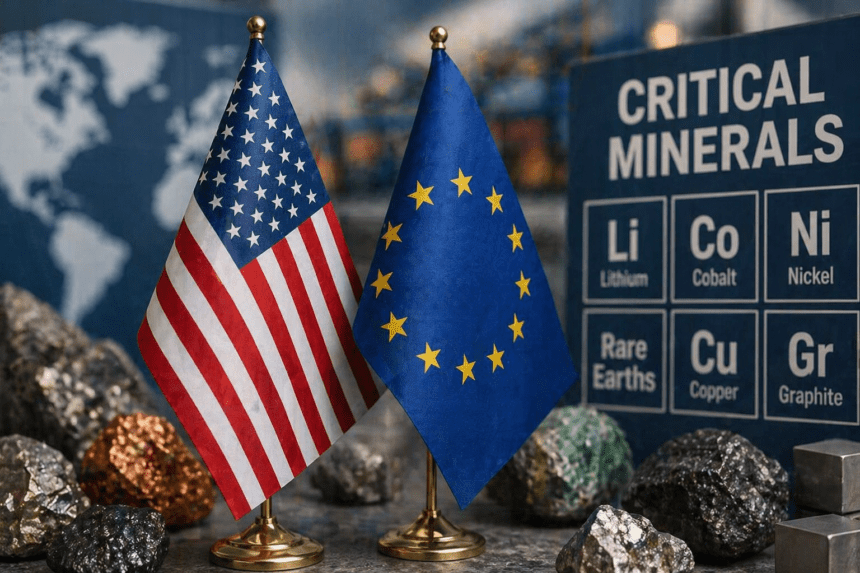
The United States and the European Union are moving to tighten cooperation on critical minerals, opening a new front in their broader economic-security agenda as both sides try to reduce dependence on highly concentrated supply chains that feed advanced manufacturing. The latest official steps build on earlier U.S.-EU talks but go further by explicitly backing joint action on export restrictions, supply-chain resilience and trade tools for minerals used in batteries, semiconductors, magnets and defence technologies.

A key marker came in the U.S.-EU trade framework announced in August 2025. In that joint statement, Washington and Brussels said they would strengthen cooperation and action related to export restrictions on critical minerals and similar resources imposed by third countries. That language did not name China directly, but the strategic target was hard to miss, given Western concerns over concentrated mineral processing and Beijing’s leverage in several downstream segments.

The effort has since widened. In February 2026, the United States, the European Commission and Japan said they would develop action plans for critical-minerals supply-chain resilience and explore a wider trade initiative with like-minded partners. Those plans include possible coordinated trade mechanisms such as border-adjusted price floors, standards-based markets, price-gap subsidies and offtake agreements — in other words, not just diplomacy, but market-shaping tools meant to make non-Chinese supply more viable.

Why the urgency? Because the market is still heavily concentrated. The International Energy Agency said in its 2025 outlook that the average share of the top three refining countries for key energy minerals rose from about 82% in 2020 to 86% in 2024, with China driving supply growth in cobalt, graphite and rare earths. The IEA also said China’s already-dominant position in refining is expected to grow further, from 45% to 50% of the global refining market share in its regional snapshot.

That matters well beyond clean energy. Critical minerals sit underneath electric vehicles, grid equipment, permanent magnets, aerospace systems, chips and defence manufacturing. The EU has been blunt about the strategic risk: its own Critical Raw Materials policy work is built around reducing dangerous dependencies as demand for battery materials, rare earths and other inputs keeps climbing.

This is not a brand-new transatlantic idea. The U.S. and EU had already announced, in 2023, their intention to negotiate a critical minerals agreement aimed at strengthening supply chains, especially around electric-vehicle batteries. But progress since then suggests the conversation has shifted. What began as a trade-and-sourcing discussion now looks much more like industrial policy with a geopolitical edge. That’s an inference from the sequence of official statements and policy documents, but it is strongly supported by the way both sides are now linking minerals to resilience, security and coercion risks.

For manufacturers, the implications could be significant. If the U.S. and EU follow through, companies may see more subsidies for alternative supply, tighter standards, more coordinated sourcing arrangements and stronger incentives to process or recycle minerals outside dominant hubs. None of that will loosen China’s grip overnight. Still, the policy direction is now pretty clear: Washington and Brussels are no longer treating critical minerals as a narrow trade issue. They are treating them as strategic infrastructure

Share This Article
Email Copy Link Print
Previous Article CDF Munir, Iran FM Araghchi discuss regional security in Islamabad meeting CDF Munir, Iran FM Araghchi discuss regional security in Islamabad meeting
Next Article President Zardari heads to China for week-long visit focused on trade, ties and CPEC President Zardari heads to China for week-long visit focused on trade, ties and CPEC
Leave a Comment

Leave a Reply Cancel reply

Your email address will not be published. Required fields are marked *

Sponsored Ads

Stay Connected

FacebookLike
XFollow
InstagramFollow
YoutubeSubscribe
WhatsAppFollow
ThreadsFollow
Fulham punish Villa lapse to keep European push alive
Sports
April 25, 2026
US to let Venezuela pay Maduro’s lawyer in drug trafficking case
Breaking
April 25, 2026
Canadian dollar edges lower against the rupee in Pakistan
Business & Commerce Headline
April 25, 2026
Trump hosts crypto contest winners at Mar-a-Lago as his coin languishes
Business & Commerce Headline
April 25, 2026
The challenges facing Canada as it inches toward trade talks
Headline Politics
April 25, 2026
A new idea to save the AMOC? Dam the Bering Strait
Climate and Weather Headline
April 25, 2026

You Might Also Like

Pakistan gets $2bn from Saudi Arabia, with more support expected
Business & Commerce

Pakistan gets $2bn from Saudi Arabia, with more support expected

By
Mabruka Khan
Iranian rial draws Pakistani buyers amid war, but traders see speculative rush rather than safe investment
Business & Commerce

Iranian rial draws Pakistani buyers amid war, but traders see speculative rush rather than safe investment

By
Misbah Jogyat
Business & Commerce

Finance Minister joins World Bank roundtable, pitches Pakistan’s digital social protection model

By
Mabruka Khan
Business & Commerce

Dollar Steady as Pakistan’s Forex Reserves Face Mid-Week Pressure

By
Amna Iqbal
Media Hyde Media Hyde Dark
Facebook Twitter Youtube Rss Medium

About US

Media Hyde Network: Your instant connection to breaking stories and live updates. Stay informed with our real-time coverage across politics, tech, entertainment, and more. Your reliable source for 24/7 News.

Top Categories
  • Headline
  • Politics
  • Entertainment
  • Education
  • Sports
  • Religious
  • Metropolitan
  • Climate and Weather
Usefull Links
  • Contact Us
  • Disclaimer
  • Privacy Policy
  • Cookies Policy
  • Advertising Policy
  • Terms & Conditions

© 2025 Media Hyde Network. All Rights Reserved.

Welcome Back!

Sign in to your account

Username or Email Address
Password

Lost your password?