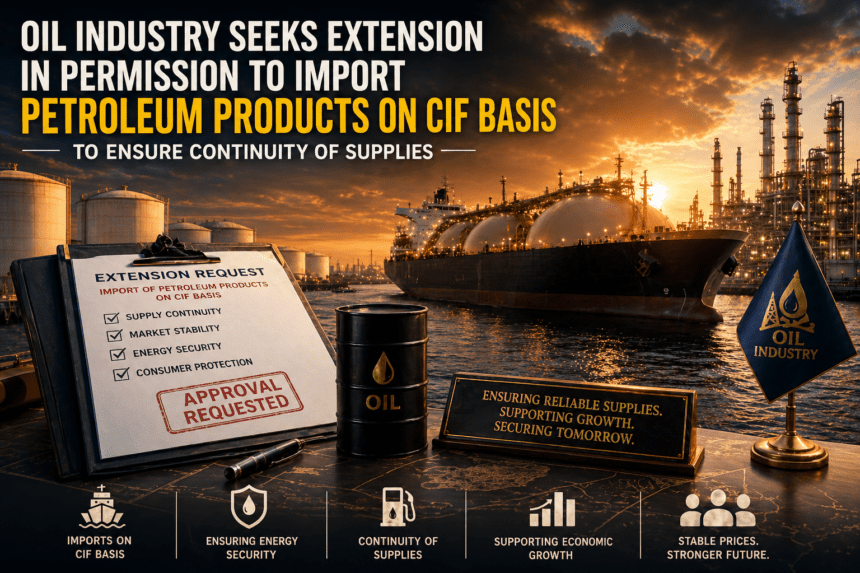
Pakistan’s oil industry has asked the government and the State Bank of Pakistan to extend a temporary relaxation that allows crude oil and petroleum products to be imported on a CIF — cost, insurance and freight — basis, warning that without it, the country could face fresh difficulties in maintaining uninterrupted fuel supplies. The request comes after the central bank, on March 11, 2026, allowed such imports for 60 days in response to what it called petroleum import challenges under prevailing geopolitical conditions.
At the center of the issue is insurance. Under Pakistan’s usual import framework, refineries and oil marketing companies bring in products on a C&F basis, where the seller covers freight to the destination port but the Pakistani buyer must arrange insurance separately, including costly war-risk cover. Industry representatives say that arrangement has become increasingly difficult in the current regional environment, with insurers either pulling back or sharply increasing premiums for vessels operating through the Persian Gulf and the Strait of Hormuz.
The industry’s argument is fairly straightforward: when global shipping markets turn jumpy, overseas suppliers are often in a better position than local buyers to secure marine insurance and war-risk coverage. That is why the Oil Companies Advisory Council earlier urged the SBP to permit imports on a CIF basis, saying the change would give importers badly needed flexibility and reduce the risk of cargo disruptions. According to reporting at the time, a Pakistan State Oil spot tender floated on a C&F basis drew no bids for petrol, diesel, and JP-1 cargoes, underscoring how tight the market had become.
The temporary relaxation was not limited to one fuel. It covered crude oil and all petroleum products, and was specifically linked to the need to facilitate imports and keep supplies moving despite volatility in freight, insurance, and vessel availability. Dawn reported that the permission included advance war-risk insurance for a limited period, reflecting official concern that the normal mechanism was no longer working smoothly enough under current conditions.
Now, with that 60-day window nearing expiry, the industry is pushing for more time. The concern is that the underlying pressures have not really gone away. Shipping and insurance markets remain sensitive to geopolitical instability, and the oil sector fears that a snap return to the standard C&F structure could once again slow procurement, raise costs further, or leave import tenders undersubscribed. That raises a practical risk for Pakistan: even when there is no immediate nationwide shortage, supply continuity can become fragile if cargo bookings start slipping. This last point is an inference based on the industry’s earlier warnings and the rationale behind the March relaxation.
The story also reflects a broader pattern in Pakistan’s energy chain. The downstream oil sector has already been dealing with thin margins, financing pressure, and regulatory complications. In that environment, even a technical matter like who arranges insurance on imported cargoes can quickly become a national supply issue. What the industry is seeking now is not a permanent rewrite of the rules, at least not publicly, but an extension long enough to avoid a break in logistics while the external market remains unsettled.
For policymakers, the choice is awkward but clear. Extend the relaxation, and they buy time for importers to navigate a still-volatile market. Let it lapse, and they risk putting the burden back on buyers just as freight and war-risk conditions remain unpredictable. In a country where fuel availability has immediate economic and political consequences, that is not a small administrative decision.