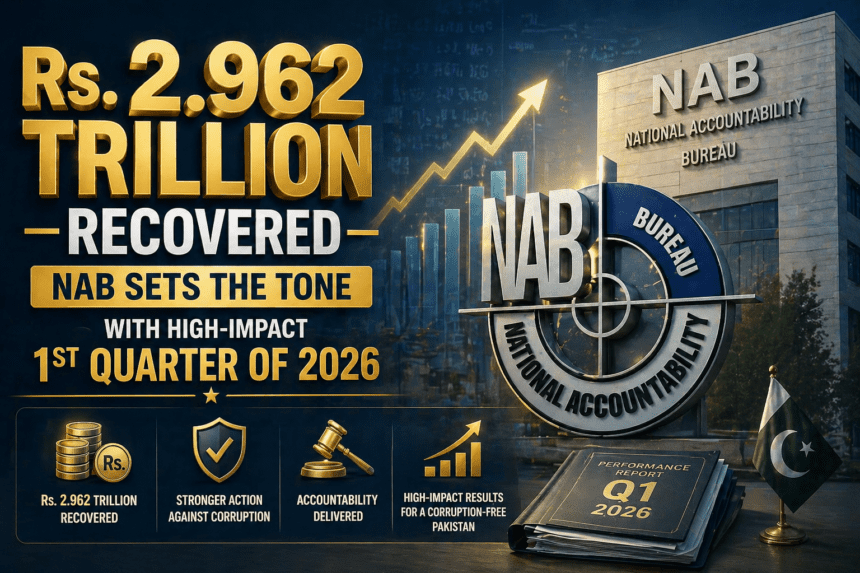
The National Accountability Bureau says it recovered Rs2.962 trillion in the first quarter of 2026, giving the agency a headline number large enough to set the tone for the rest of the year. Pakistani media reports on Tuesday said the bulk of that amount came from major land recoveries, with Karachi and Sukkur contributing the largest share through the reclamation of 54,387 acres of government land valued at Rs2.89 trillion.
Other regional bureaus also featured in the quarter’s recovery picture. The same reporting said Lahore and Multan recovered 4,034 acres worth Rs23.33 billion, while Balochistan added another 51,576 acres valued at Rs36.54 billion during the January-to-March period. That Balochistan number lines up with separate recent reporting on NAB’s land recovery campaign in the province.
What makes the figure stand out is the backdrop. NAB’s officially publicised 2025 annual performance report said the bureau recovered Rs6.213 trillion during 2025, the highest annual total since its creation in 1999, and pushed its three-year cumulative recoveries to Rs11.524 trillion. The bureau’s own 2025 narrative also leaned heavily on land reclamation as the central driver of those recoveries, especially in Sukkur, Balochistan and Multan.
So this latest quarter doesn’t come out of nowhere. It looks more like a continuation of a strategy NAB has already been advertising: go after large public-asset recoveries, particularly encroached land, and present those actions as proof of institutional muscle. The bureau’s website also shows that it has continued to publish recovery-focused updates in 2026, including major land retrieval announcements from Karachi.
There is, though, one important note of caution. While the Rs2.962 trillion first-quarter figure is being circulated in current reporting, I did not find a directly accessible detailed NAB press release for that specific Q1 2026 summary during this check. NAB has published quarterly recovery updates before, including an official first-quarter update for 2025, so the format is not unusual. But for this particular 2026 quarter, the figure is best attributed carefully as a reported NAB claim unless and until the bureau posts the full quarterly breakdown on its site.
Even with that caveat, the message NAB appears to be sending is unmistakable: after a record 2025, it wants 2026 to begin with the image of momentum, scale and visible impact. Whether that translates into broader public confidence is another question. But on paper, at least, the first quarter has given the bureau a very loud opening statement.