The Punjab government has laid out a tightly controlled framework for Basant’s return, allowing kite flying only under strict safety rules after years of restrictions driven by fatal accidents linked to hazardous string. Official festival material and recent legal reporting show that Basant 2026 is being planned for February 6 to 8 in Lahore, not as a free-for-all revival, but as a regulated event with district-level oversight and limited permission.
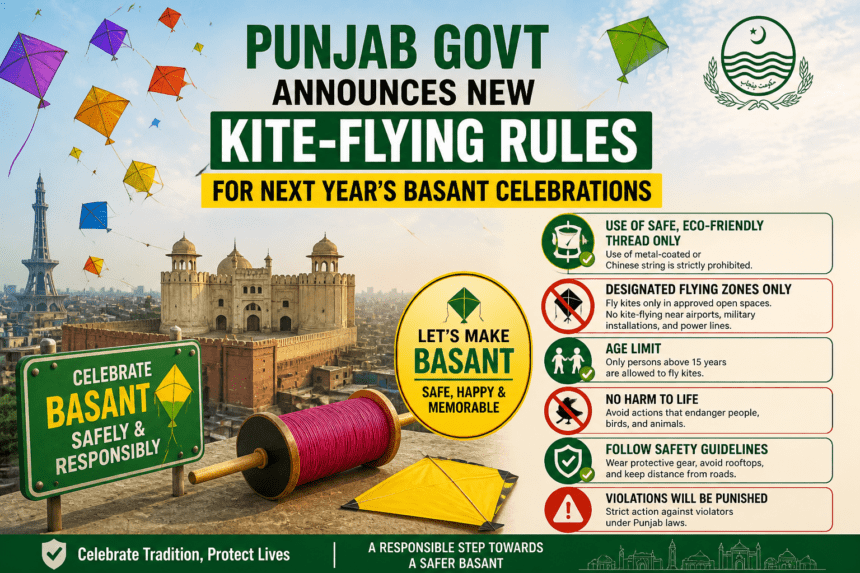
The biggest rule change is on, kite string. Only approved cotton thread is allowed, while metallic wire, nylon string, and chemically or glass-coated thread remain banned because of the danger they pose to motorcyclists, pedestrians, and children. The government has also moved to create a traceable supply chain by requiring registration of manufacturers, traders, and sellers.
The new system is built around permissions and monitoring. Kite-flying associations must be registered with the deputy commissioner concerned, shopkeepers are to be registered and linked through QR-code tracking, and district authorities are expected to confirm readiness before celebrations are allowed. Permission for actual kite flying is tied to official approval rather than automatic public access.
There are also age and liability limits. Those under 18 years of age are not allowed to fly kites under the notified framework, and responsibility for violations can fall on parents or guardians. That reflects the government’s attempt to treat Basant not simply as a cultural event, but as a public-safety issue after years of deaths and serious injuries tied to dangerous kite-flying practices.
Punishments are intentionally severe. Recent reports and the notified framework describe jail terms and heavy fines for the manufacture, sale, storage or use of prohibited string or unauthorized kite-flying material. The message from the government is clear: Basant may be back, but only in a controlled, heavily regulated form.