By using this site, you agree to the Privacy Policy and Terms of Use.
Accept
Media HydeMedia Hyde
  • Home
  • Politics
  • Education
  • Entertainment
  • Sports
  • Blogs
  • Business & Commerce
  • Others
    • Religious
    • Metropolitan
    • Climate and Weather
Font ResizerAa
Media HydeMedia Hyde
Font ResizerAa
  • Home
  • Politics
  • Education
  • Entertainment
  • Sports
  • Blogs
  • Business & Commerce
  • Others
    • Religious
    • Metropolitan
    • Climate and Weather
Follow US
© 2026 Media Hyde Network. All Rights Reserved.
Breaking

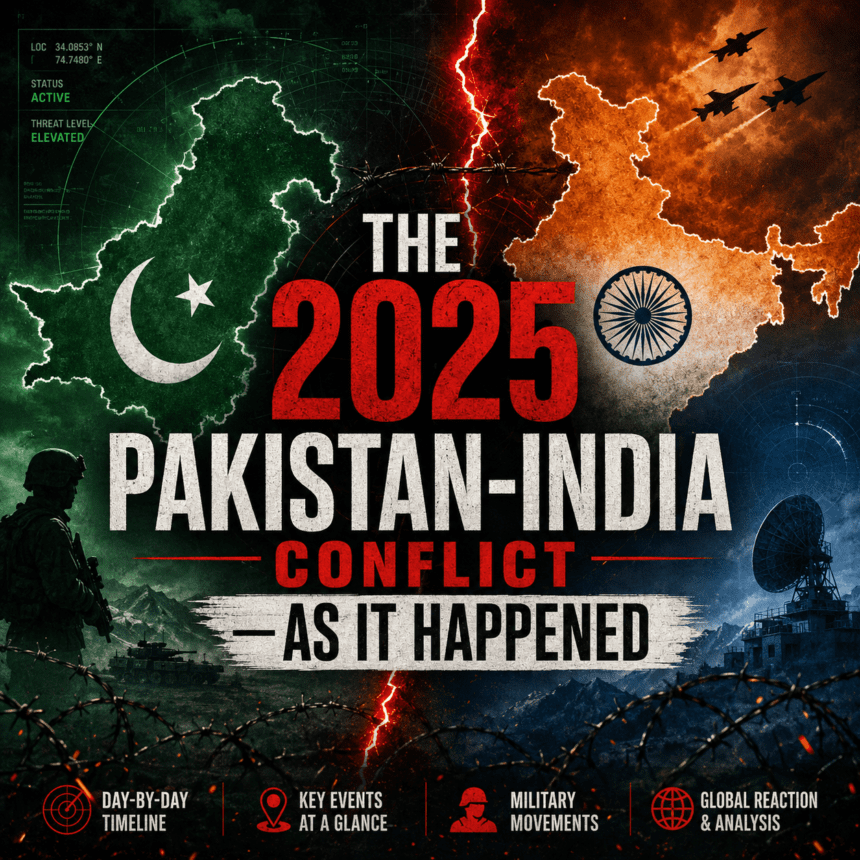
The 2025 Pakistan-India conflict — as it happened

Last updated: May 6, 2026 1:04 pm
Ayesha Masood
Share
The 2025 Pakistan-India conflict — as it happened
SHARE

The 2025 Pakistan-India conflict unfolded over just a few days in May, but the fuse was lit earlier, with the April 22 attack in Pahalgam in Indian-administered Kashmir, where gunmen killed at least 26 people, most of them tourists. The massacre jolted the region, triggered outrage in India, and set off a fast-moving diplomatic and military crisis between the two nuclear-armed neighbours.

April 22, 2025: Pahalgam attack shocks the region
Militants opened fire in the Baisaran meadow area near Pahalgam, killing at least 26 people and injuring many others, in one of the deadliest attacks on civilians in Kashmir in recent years. The attack immediately changed the political mood. Indian leaders vowed a strong response, while Pakistan rejected Indian allegations that it was linked to the assault.

Late April: Diplomacy breaks down
In the days after the attack, the confrontation widened beyond rhetoric. India announced punitive steps against Pakistan, including suspension of the Indus Waters Treaty, while both countries rolled out retaliatory diplomatic measures, tightening an already tense relationship. By that stage, the crisis was no longer just about the attack itself; it had become a broader state-to-state standoff.

May 7: India launches Operation Sindoor
The conflict turned openly military on May 7, when India said it had carried out strikes under Operation Sindoor, targeting nine sites in Pakistan and Pakistan-administered Kashmir. India described the operation as precise and non-escalatory, saying it was aimed at militant infrastructure rather than Pakistani military facilities. Pakistan, on the other hand, said civilian areas were hit and reported casualties. That same day, reports pointed to a major aerial engagement and heavy cross-border fire.

May 8–9: Drones, missiles and rising fear
As the crisis deepened, both sides accused each other of fresh attacks involving drones, missiles and shelling. Reuters’ later reconstruction of the crisis said South Asia was pulled close to the brink as missile strikes, drone attacks and warnings of further escalation fed fears that the confrontation could spiral badly. Civilian anxiety rose across border regions, and the sense that events were moving faster than diplomacy became hard to ignore.

May 10: Ceasefire announced
On May 10, India and Pakistan agreed to an immediate ceasefire after mediation efforts involving the United States. The agreement was publicly confirmed by U.S. officials and then acknowledged by both sides. It was a sudden turn, honestly, because only hours earlier the conflict still appeared to be intensifying. The ceasefire covered military action across land, air and sea.

Hours later: claims of violations
The relief did not last cleanly. Within hours of the ceasefire announcement, India accused Pakistan of violating the truce, while Pakistan said it remained committed to the agreement and blamed India for renewed trouble. Reports from Kashmir described explosions and fresh tension even after the formal halt in hostilities. So yes, the ceasefire held in principle, but its first hours were visibly shaky.

Aftermath: a short war with a long shadow
Although the direct fighting lasted only a brief period, the crisis left behind a harder political climate, fresh military claims on both sides, and unresolved questions over deterrence, escalation and future Kashmir-linked violence. Subsequent reporting and official statements made clear that both India and Pakistan emerged claiming success, even as outside powers pushed to prevent another slide toward war.

What defined the conflict
What made the 2025 conflict especially alarming was not only the speed of escalation, but how quickly it moved from a militant attack to interstate military action. First came the massacre in Pahalgam. Then the diplomatic rupture. Then air and missile strikes, drone accusations and cross-border exchanges. Then, almost abruptly, a ceasefire. It was brief. It was dangerous. And it reminded the region, again, how thin the line is between crisis and war.


Share This Article
Email Copy Link Print
Previous Article Sindh Pink Games reportedly postponed as intense heat grips the province Sindh Pink Games reportedly postponed as intense heat grips the province
Next Article FIFA summons Iranian football officials to Zurich for World Cup talks
Leave a Comment

Leave a Reply Cancel reply

Your email address will not be published. Required fields are marked *

Sponsored Ads

Stay Connected

FacebookLike
XFollow
InstagramFollow
YoutubeSubscribe
WhatsAppFollow
ThreadsFollow
Sindh Schools to Close for Two-Month Summer Break Starting June 1
Education
May 13, 2026
Pakistan Targets Tech Workforce with 20,000 AI Training Slots
Education
May 13, 2026
Tokyo University Launches Fully Autonomous Lab Where Robots Run the Show The lights are on at the University of Tokyo’s newest chemistry lab, but the lab coats are gone. In a move that signals a shift for experimental science, the university has officially opened a facility where robots handle the entire research cycle—from mixing chemicals to analyzing results—without a single human in the room. This isn’t just a room with a few automated arms. It’s a closed-loop system designed to hunt for new materials for batteries and semiconductors at speeds that make traditional methods look like they’re standing still. The AI designs the experiment, the robots execute it, and the data feeds right back into the AI to decide what happens next. "The goal is to remove the bottleneck of human physical labor," a researcher involved in the project’s pilot phase said. "A human can do maybe ten experiments a day. This system won't stop at ten, and it doesn't need to go home at 5:00 PM." The stakes are high. Japan is currently locked in a global race to find more efficient materials for the next generation of electric vehicle batteries. By cutting humans out of the "pipette-and-wait" cycle, the university expects to compress years of trial-and-error into a few weeks of non-stop robotic iteration. It’s a response to a looming crisis, too. Japan’s shrinking workforce means there are fewer young scientists entering the field every year. Automating the grunt work isn't just about speed; it’s about survival in a country where human talent is becoming a scarce resource. Critics often worry that "robot-run" means "job-lost," but the university’s lead engineers argue the opposite. They say the move frees up researchers to actually think, rather than spending eight hours a day performing repetitive liquid handling. The robots don't get bored, they don't make clerical errors, and they don't suffer from "Friday afternoon" fatigue that can ruin a data set. The lab is currently focused on thin-film materials, but the team plans to scale the technology to other branches of chemistry soon. If it works, the image of the lone scientist hunched over a workbench might soon be a relic of the past. The lab is running right now. It’ll be running tomorrow morning. And it won't need a coffee break to get through the night.
Tokyo University Launches Fully Autonomous Lab Where Robots Run the Show
Education
May 13, 2026
Pakistan Offers New Higher Education Scholarships to Bangladeshi Students
Education
May 13, 2026
Private Schools Defy Punjab Government’s Revised Summer Vacation Schedule
Education
May 13, 2026
HEC Drops Paperwork: Fully Online Degree Attestation Goes Live Nationwide
Education
May 13, 2026

You Might Also Like

BreakingPolitics

Saudi Arabia, United Arab Emirates, and Qatar Allegedly Refuse to Allow U.S. Use of Their Territory Against Iran

By
Shabih Abbas
Pakistan joins more than 20 countries in condemning Israel’s Somaliland move
BreakingPoliticsWorld

Pakistan joins more than 20 countries in condemning Israel’s Somaliland move

By
Ayesha Masood
Trump Casts Iran War as Nearing the Finish Line, but the Reality Is Messier
BreakingPoliticsWorld

Trump Casts Iran War as Nearing the Finish Line, but the Reality Is Messier

By
Ayesha Masood
Breaking

Pentagon Says No Intelligence Iran Planned Initial Attack on US Forces

By
Hamna Raees
Media Hyde Media Hyde Dark
Facebook Twitter Youtube Rss Medium

About US

Media Hyde Network: Your instant connection to breaking stories and live updates. Stay informed with our real-time coverage across politics, tech, entertainment, and more. Your reliable source for 24/7 News.

Top Categories
  • Headline
  • Politics
  • Entertainment
  • Education
  • Sports
  • Religious
  • Metropolitan
  • Climate and Weather
Usefull Links
  • Contact Us
  • Disclaimer
  • Privacy Policy
  • Cookies Policy
  • Advertising Policy
  • Terms & Conditions

© 2025 Media Hyde Network. All Rights Reserved.

Welcome Back!

Sign in to your account

Username or Email Address
Password

Lost your password?