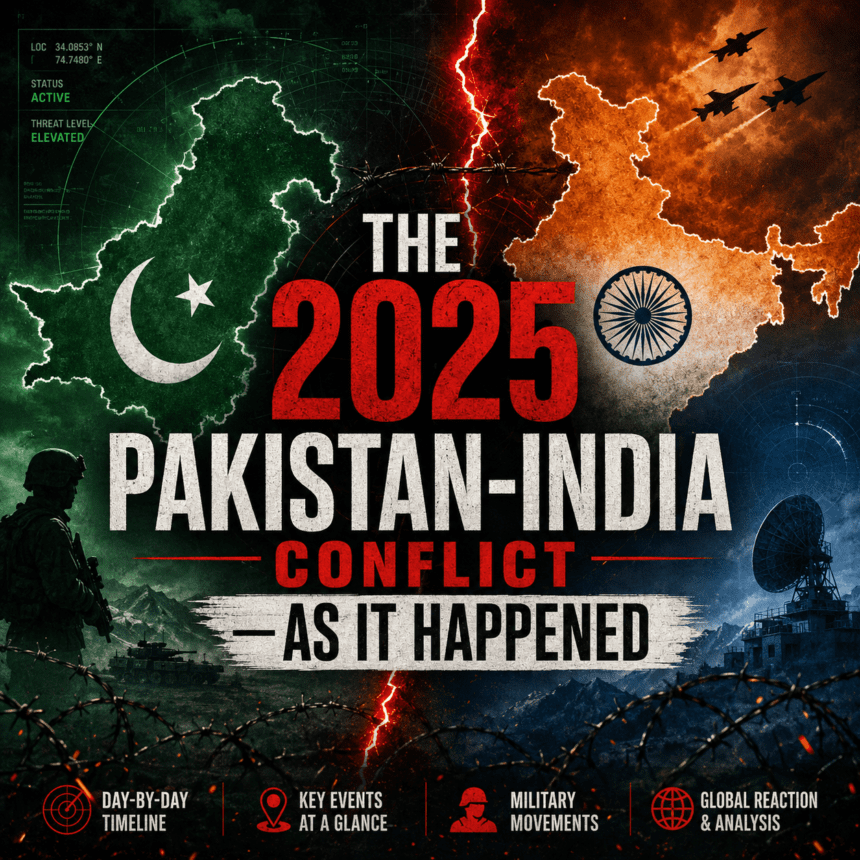
The 2025 Pakistan-India conflict unfolded over just a few days in May, but the fuse was lit earlier, with the April 22 attack in Pahalgam in Indian-administered Kashmir, where gunmen killed at least 26 people, most of them tourists. The massacre jolted the region, triggered outrage in India, and set off a fast-moving diplomatic and military crisis between the two nuclear-armed neighbours.
April 22, 2025: Pahalgam attack shocks the region
Militants opened fire in the Baisaran meadow area near Pahalgam, killing at least 26 people and injuring many others, in one of the deadliest attacks on civilians in Kashmir in recent years. The attack immediately changed the political mood. Indian leaders vowed a strong response, while Pakistan rejected Indian allegations that it was linked to the assault.
Late April: Diplomacy breaks down
In the days after the attack, the confrontation widened beyond rhetoric. India announced punitive steps against Pakistan, including suspension of the Indus Waters Treaty, while both countries rolled out retaliatory diplomatic measures, tightening an already tense relationship. By that stage, the crisis was no longer just about the attack itself; it had become a broader state-to-state standoff.
May 7: India launches Operation Sindoor
The conflict turned openly military on May 7, when India said it had carried out strikes under Operation Sindoor, targeting nine sites in Pakistan and Pakistan-administered Kashmir. India described the operation as precise and non-escalatory, saying it was aimed at militant infrastructure rather than Pakistani military facilities. Pakistan, on the other hand, said civilian areas were hit and reported casualties. That same day, reports pointed to a major aerial engagement and heavy cross-border fire.
May 8–9: Drones, missiles and rising fear
As the crisis deepened, both sides accused each other of fresh attacks involving drones, missiles and shelling. Reuters’ later reconstruction of the crisis said South Asia was pulled close to the brink as missile strikes, drone attacks and warnings of further escalation fed fears that the confrontation could spiral badly. Civilian anxiety rose across border regions, and the sense that events were moving faster than diplomacy became hard to ignore.
May 10: Ceasefire announced
On May 10, India and Pakistan agreed to an immediate ceasefire after mediation efforts involving the United States. The agreement was publicly confirmed by U.S. officials and then acknowledged by both sides. It was a sudden turn, honestly, because only hours earlier the conflict still appeared to be intensifying. The ceasefire covered military action across land, air and sea.
Hours later: claims of violations
The relief did not last cleanly. Within hours of the ceasefire announcement, India accused Pakistan of violating the truce, while Pakistan said it remained committed to the agreement and blamed India for renewed trouble. Reports from Kashmir described explosions and fresh tension even after the formal halt in hostilities. So yes, the ceasefire held in principle, but its first hours were visibly shaky.
Aftermath: a short war with a long shadow
Although the direct fighting lasted only a brief period, the crisis left behind a harder political climate, fresh military claims on both sides, and unresolved questions over deterrence, escalation and future Kashmir-linked violence. Subsequent reporting and official statements made clear that both India and Pakistan emerged claiming success, even as outside powers pushed to prevent another slide toward war.
What defined the conflict
What made the 2025 conflict especially alarming was not only the speed of escalation, but how quickly it moved from a militant attack to interstate military action. First came the massacre in Pahalgam. Then the diplomatic rupture. Then air and missile strikes, drone accusations and cross-border exchanges. Then, almost abruptly, a ceasefire. It was brief. It was dangerous. And it reminded the region, again, how thin the line is between crisis and war.