By using this site, you agree to the Privacy Policy and Terms of Use.
Accept
Media HydeMedia Hyde
  • Home
  • Politics
  • Education
  • Entertainment
  • Sports
  • Blogs
  • Business & Commerce
  • Others
    • Religious
    • Metropolitan
    • Climate and Weather
Font ResizerAa
Media HydeMedia Hyde
Font ResizerAa
  • Home
  • Politics
  • Education
  • Entertainment
  • Sports
  • Blogs
  • Business & Commerce
  • Others
    • Religious
    • Metropolitan
    • Climate and Weather
Follow US
© 2026 Media Hyde Network. All Rights Reserved.
Climate and WeatherHeadline

Heatwave grips Pakistan: Emergency measures as temperatures cross 45°C

Last updated: May 10, 2026 6:13 pm
Ayesha Masood
Share
Heatwave grips Pakistan: Emergency measures as temperatures cross 45°C
SHARE

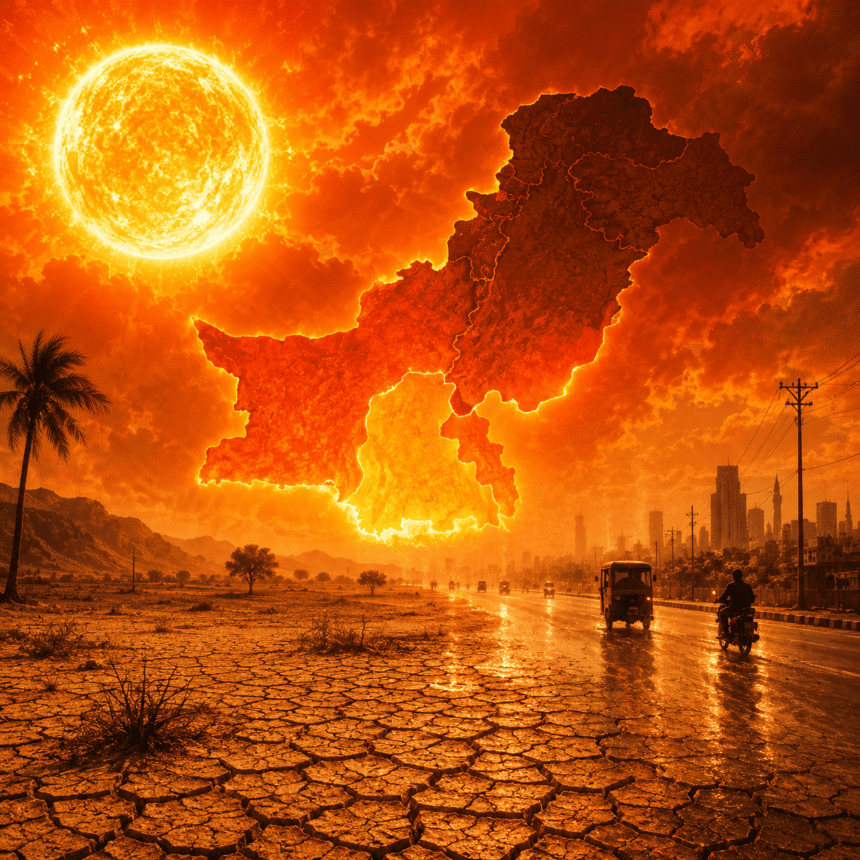
The mercury surged past 45°C across Sindh, Balochistan, and southern Punjab today, leaving millions to endure a relentless heatwave that shows no signs of breaking. Hospitals in Karachi, Hyderabad, and Jacobabad report a spike in heatstroke cases, while the power grid struggles to keep pace with the desperate demand for electricity.

The Pakistan Meteorological Department (PMD) issued a red alert, warning that the extreme heat will persist for at least another 72 hours. While coastal areas are seeing slightly lower readings, the humidity is pushing the “feels-like” temperature well into the danger zone, making the air stifling for anyone outdoors.

In Jacobabad—often cited as one of the hottest cities on Earth—residents have retreated indoors, leaving streets deserted by mid-morning. Local administration has set up “heat relief centers” equipped with water stations and basic medical supplies, but the scale of the crisis is testing local resources.

“We are seeing a 30% increase in patients reporting dizziness, fainting, and severe dehydration,” said Dr. Tariq Mansoor, a senior physician at a public hospital in Hyderabad. He warned that the elderly and children are at the highest risk, urging families to avoid direct sun exposure between 11:00 AM and 4:00 PM.

The economic impact is mounting. Agricultural workers in southern Punjab have shifted their shifts to pre-dawn hours to avoid the midday sun, slowing the harvest cycle. Meanwhile, urban centers are suffering from unannounced power outages, a recurring failure that turns homes into ovens during the peak heat.

The provincial governments have directed schools to adjust their timings, but critics argue these measures are reactive rather than preventative. With the climate changing, the frequency of these extreme events is rising, yet the infrastructure to shield the public remains largely unchanged from a decade ago.


As the sun sets, the temperature in many areas is barely dipping below 30°C, providing little recovery time for the human body. For now, the advice from the health ministry is blunt: stay inside, stay hydrated, and pray for the sea breeze to finally push inland.
Share This Article
Email Copy Link Print
Previous Article Sindh Chief Minister Reviews Red Line Progress Amid Karachi Traffic Woes Sindh Chief Minister Reviews Red Line Progress Amid Karachi Traffic Woes
Next Article First passengers leave virus-stricken cruise ship as quarantine ends First passengers leave virus-stricken cruise ship as quarantine ends
Leave a Comment

Leave a Reply Cancel reply

Your email address will not be published. Required fields are marked *

Sponsored Ads

Stay Connected

FacebookLike
XFollow
InstagramFollow
YoutubeSubscribe
WhatsAppFollow
ThreadsFollow
Sindh Schools to Close for Two-Month Summer Break Starting June 1
Education
May 13, 2026
Pakistan Targets Tech Workforce with 20,000 AI Training Slots
Education
May 13, 2026
Tokyo University Launches Fully Autonomous Lab Where Robots Run the Show The lights are on at the University of Tokyo’s newest chemistry lab, but the lab coats are gone. In a move that signals a shift for experimental science, the university has officially opened a facility where robots handle the entire research cycle—from mixing chemicals to analyzing results—without a single human in the room. This isn’t just a room with a few automated arms. It’s a closed-loop system designed to hunt for new materials for batteries and semiconductors at speeds that make traditional methods look like they’re standing still. The AI designs the experiment, the robots execute it, and the data feeds right back into the AI to decide what happens next. "The goal is to remove the bottleneck of human physical labor," a researcher involved in the project’s pilot phase said. "A human can do maybe ten experiments a day. This system won't stop at ten, and it doesn't need to go home at 5:00 PM." The stakes are high. Japan is currently locked in a global race to find more efficient materials for the next generation of electric vehicle batteries. By cutting humans out of the "pipette-and-wait" cycle, the university expects to compress years of trial-and-error into a few weeks of non-stop robotic iteration. It’s a response to a looming crisis, too. Japan’s shrinking workforce means there are fewer young scientists entering the field every year. Automating the grunt work isn't just about speed; it’s about survival in a country where human talent is becoming a scarce resource. Critics often worry that "robot-run" means "job-lost," but the university’s lead engineers argue the opposite. They say the move frees up researchers to actually think, rather than spending eight hours a day performing repetitive liquid handling. The robots don't get bored, they don't make clerical errors, and they don't suffer from "Friday afternoon" fatigue that can ruin a data set. The lab is currently focused on thin-film materials, but the team plans to scale the technology to other branches of chemistry soon. If it works, the image of the lone scientist hunched over a workbench might soon be a relic of the past. The lab is running right now. It’ll be running tomorrow morning. And it won't need a coffee break to get through the night.
Tokyo University Launches Fully Autonomous Lab Where Robots Run the Show
Education
May 13, 2026
Pakistan Offers New Higher Education Scholarships to Bangladeshi Students
Education
May 13, 2026
Private Schools Defy Punjab Government’s Revised Summer Vacation Schedule
Education
May 13, 2026
HEC Drops Paperwork: Fully Online Degree Attestation Goes Live Nationwide
Education
May 13, 2026

You Might Also Like

Climate and Weather

Significant Improvement in Lahore’s Air Quality as Smog Levels Decline

By
Anoosha Malik
Climate and Weather

Vermont Unveils Bold Climate Plan Amid Federal Cuts, Uncertainty Over Emissions Goals

By
Sana Mustafa
HeadlineTravel

Thousands of Pakistanis Deported for Begging, Shocking Revelations in Parliament

By
Salman Khan
Climate and Weather

Charity pledges millions to plug river conservation funding

By
adilmahmood
Media Hyde Media Hyde Dark
Facebook Twitter Youtube Rss Medium

About US

Media Hyde Network: Your instant connection to breaking stories and live updates. Stay informed with our real-time coverage across politics, tech, entertainment, and more. Your reliable source for 24/7 News.

Top Categories
  • Headline
  • Politics
  • Entertainment
  • Education
  • Sports
  • Religious
  • Metropolitan
  • Climate and Weather
Usefull Links
  • Contact Us
  • Disclaimer
  • Privacy Policy
  • Cookies Policy
  • Advertising Policy
  • Terms & Conditions

© 2025 Media Hyde Network. All Rights Reserved.

Welcome Back!

Sign in to your account

Username or Email Address
Password

Lost your password?