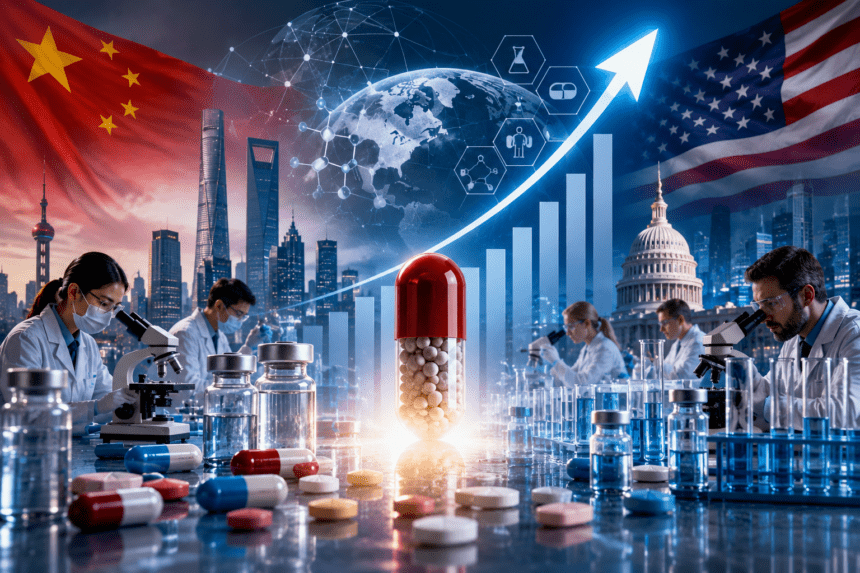
The U.S. grip on global pharmaceutical innovation is loosening. For decades, American firms dictated the pace of drug discovery, but new data points to a rapid shift toward China, where state-backed investment and a massive pool of clinical trial data are rewriting the rules of the industry. Washington is feeling the pressure.
The U.S. House of Representatives recently pushed forward the BIOSECURE Act, a legislative attempt to decouple American medical supply chains from Chinese biotech giants like BGI Group and WuXi AppTec. Lawmakers argue these companies pose a national security risk, citing concerns over the handling of genetic data. But the legislation highlights a deeper reality: the U.S. can no longer simply outspend or out-innovate its way out of the competition.
Chinese research output has surged. In 2023, the number of novel drug applications filed in China by domestic firms surpassed those from international players for the first time. The country’s biotech sector has shifted from “copycat” manufacturing to original research, fueled by a government-led strategy that integrates clinical trials into its vast, centralized hospital network.
“We are seeing a speed of execution that is difficult to replicate in the West,” says a senior analyst at a leading global health consultancy. “They aren’t just filing more patents; they are moving those candidates through the pipeline at a fraction of the cost.
” The cost advantage is stark. Developing a new drug in the U.S. remains a multi-billion-dollar gamble, often taking over a decade. In China, the integration of AI-driven drug discovery combined with lower labor costs and streamlined regulatory pathways—has compressed those timelines. American firms, meanwhile, remain bogged down by rising clinical trial expenses and a complex, fragmented healthcare landscape.
This shift has forced a reckoning in boardrooms from Cambridge to San Francisco. Big Pharma companies that relied on Chinese labs for contract research are now scrambling to diversify, fearing that a total decoupling could leave them without the manufacturing capacity they need to survive.
The political friction is only the beginning. As the U.S. attempts to build a firewall around its biotech sector, it risks isolating itself from the very data pools that are currently accelerating global medical breakthroughs.
If the U.S. loses its lead in the race for the next generation of cancer therapies and gene-editing treatments, the consequences will extend far beyond the stock market. It will mean the next major medical breakthrough is just as likely to bear a “Made in China” label as it is to come from a U.S. laboratory.