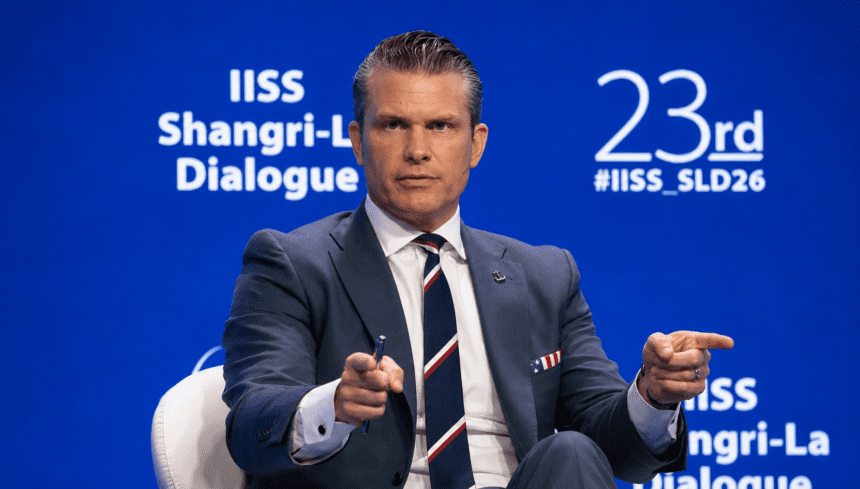
US Defense Secretary Pete Hegseth has said the United States and Pakistan are developing a “true friendship,” praising Islamabad’s role in efforts to support peace negotiations between Washington and Tehran.
Hegseth made the remarks on May 30, 2026, during the Shangri-La Dialogue in Singapore, where he was asked about regional security and Washington’s engagement with South Asian partners. While his speech had focused partly on India, the Pentagon chief said Pakistan also deserved mention because of the role its leadership was playing in diplomatic efforts linked to Iran.
“I could have very easily mentioned Pakistan,” Hegseth said, according to reports, pointing to the involvement of Prime Minister Shehbaz Sharif and Field Marshal Asim Munir in the peace process. He said the US and Pakistan were building what he described as a “true friendship,” language that stands out given the long, often uneven history of ties between the two countries.
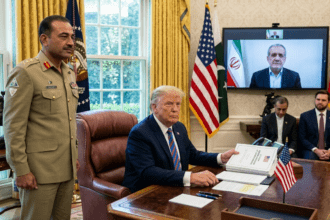
His comments came at a tense moment. The United States and Iran have been engaged in delicate negotiations following a ceasefire framework reached earlier this year, with Pakistan reportedly acting as one of the channels helping messages move between the two sides. Islamabad has maintained ties with Tehran while also seeking to improve relations with Washington, making it a useful — if careful — interlocutor.
At the same forum, Hegseth also warned that the US remained ready to resume military strikes on Iran if diplomacy failed. That blunt message showed just how fragile the situation remains. On one hand, Washington says it wants a negotiated outcome. On the other, it is keeping military pressure clearly on the table.
For Pakistan, Hegseth’s public praise is diplomatically significant. Islamabad has often tried to position itself as a bridge in regional crises, especially when Muslim-majority states and Western powers are involved. This time, the stakes are especially high: Iran is Pakistan’s neighbour, the US remains a major global power, and any renewed conflict in the Gulf could have immediate consequences for energy prices, remittances and regional security.
The remarks may also signal a modest warming in US-Pakistan relations. After years of mistrust tied to Afghanistan, counterterrorism and Washington’s growing strategic partnership with India, American officials have recently appeared more open to acknowledging Pakistan’s role in specific security and diplomatic files. Hegseth’s reference to a “true friendship” will likely be welcomed in Islamabad for that reason.
Still, the balance is delicate. Hegseth also reaffirmed India’s importance as a strategic partner for the United States, meaning Washington is not moving away from New Delhi. Instead, the US appears to be treating India and Pakistan through different lenses: India as a long-term Indo-Pacific partner, Pakistan as a country with influence in regional security, counterterrorism and Middle East diplomacy.
Islamabad, for its part, will likely see the remarks as validation of its recent diplomatic posture. Pakistan has tried to avoid being boxed into one camp, maintaining working ties with China, the Gulf states, Iran and the United States at the same time. That approach is not easy, and it often invites pressure from different sides. But in the Iran talks, it seems to have given Pakistan some room to play a useful role.
Whether this “true friendship” becomes a lasting shift or simply a warm phrase at a security conference remains to be seen. For now, Hegseth’s statement gives Pakistan a rare moment of public appreciation from Washington — and places Islamabad’s quiet diplomacy over Iran more firmly in the spotlight.