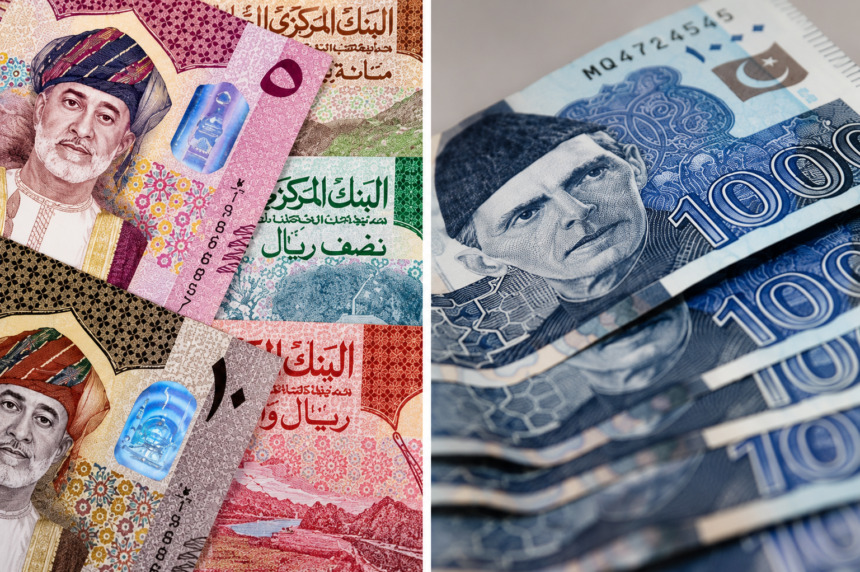
The Omani rial stayed mostly stable against the Pakistani rupee in May 2026, with mid-market exchange trackers placing the currency around the Rs723–724 range near the end of the month.
According to Wise’s historical exchange-rate data, 1 OMR stood at about Rs723.2 on May 30, while the final-week range remained extremely narrow, moving between roughly Rs723.224 and Rs723.312. That’s barely any movement, and it suggests the Omani rial avoided the kind of sharp swings sometimes seen in Pakistan’s open currency market.
Investing.com’s historical data showed a slightly higher but still steady level, with the Omani rial quoted around Rs724.18 on May 1 and staying close to that band in the early part of the month. In simple terms, May was not a dramatic month for OMR/PKR. The pair moved, but not much.
ExchangeRates.org.uk data also pointed to a broadly range-bound trend. It placed the average OMR/PKR rate for 2026 at around Rs726.27, while listing the weakest level of the year at Rs721.11 on May 24. After that brief dip, the rate recovered toward the Rs724 area in the final days of May.
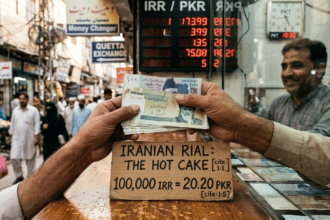
Open-market rates, however, were lower than online mid-market rates. ARY News reported the Omani rial at Rs720.38 buying and Rs731.25 selling on May 23. By May 25, the rate had eased to Rs718.48 buying and Rs729.25 selling, showing a small decline in local cash-market quotes.
That gap matters for ordinary customers. A person checking online may see the Omani rial near Rs724, but someone exchanging cash at a local exchange company may be quoted a buying rate closer to Rs718 or Rs719, depending on the dealer, city, demand, supply and spread. Banks and remittance companies may show another rate altogether.
For Pakistanis living and working in Oman, the rial’s stability is useful. Remittance senders usually prefer predictable exchange rates, because even a Rs5 to Rs10 movement per rial can affect the final rupee amount received by families back home. With the Omani rial holding close to the same range in May, households relying on Gulf remittances faced fewer surprises.
The rial itself remains one of the stronger Gulf currencies, supported by Oman’s managed exchange-rate system and its link to the US dollar. The Pakistani rupee, meanwhile, continued to move under the influence of foreign exchange reserves, import payments, remittance inflows, inflation expectations and overall dollar liquidity.
Overall, May 2026 was a quiet month for the Omani rial against the Pakistani rupee. The mid-market rate hovered near Rs723–724, open-market buying rates stayed lower, and the broader trend remained stable rather than volatile. For anyone sending money or converting currency, the practical takeaway is clear: check the actual bank or exchange-company rate before making a transaction, because headline rates rarely match the final rate offered at the counter.