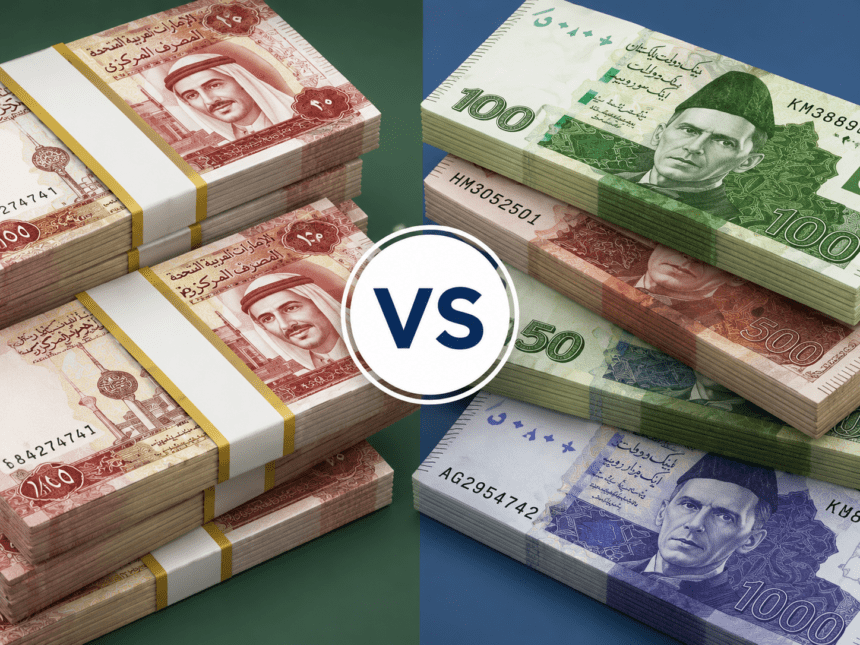
The Kuwaiti dinar remained one of the strongest foreign currencies against the Pakistani rupee in May 2026, with most mid-market and interbank-style trackers placing the rate close to the Rs900–908 range during the final week of the month.
According to Wise’s historical exchange-rate data, the KWD/PKR rate moved between Rs907.97 on May 25 and Rs899.89 on May 29, showing a mild but noticeable dip near the end of the month. Wise also recorded the biggest one-day move of the week on May 29, when the dinar fell by around 0.86% against the rupee.
Investing.com’s historical table showed a slightly higher band, with the Kuwaiti dinar quoted around Rs907–908 through much of the last week. It listed the rate at Rs908.22 on May 29, Rs908.13 on May 27 and Rs907.80 on May 25. That difference isn’t unusual, because exchange-rate platforms often use different data feeds, cut-off times and market conventions.
Open-market quotes told a different story, though. ARY News reported the Kuwaiti dinar at Rs878.70 buying and Rs889.25 selling on May 23. By May 25, the rate had eased to Rs876.38 buying and Rs887.25 selling, showing a small decline in cash-market pricing over the weekend period.
That gap between mid-market trackers and open-market rates is important. For ordinary customers, especially people exchanging cash or receiving remittances, the rate they actually get depends on the exchange company, bank, transfer service and the spread between buying and selling prices. So while online trackers may show KWD near Rs900 or above, the open-market buying rate can be lower.
For 2026 overall, the Kuwaiti dinar has stayed broadly firm against the rupee. ExchangeRates.org.uk placed the average KWD/PKR rate for the year at around Rs907.81, while listing the weakest point at Rs895.58 on May 23. That suggests May’s movement was more of a modest correction than a sharp break in trend.
The dinar’s strength is not new. Kuwait’s currency is backed by a high-income, oil-rich economy and has long traded as one of the world’s most valuable currencies. For Pakistan, meanwhile, the rupee’s performance remains tied to foreign exchange reserves, import payments, remittances, inflation expectations and overall dollar liquidity in the market.
For Pakistani workers in Kuwait and their families back home, even small changes matter. A difference of Rs10 to Rs20 per dinar can shift the rupee value of monthly remittances quite a bit, especially for households depending on Gulf income for rent, school fees or daily expenses.
By the end of May 2026, the broad picture was fairly stable: the Kuwaiti dinar stayed strong, the Pakistani rupee avoided any dramatic slide, and the market continued to show a clear split between online mid-market rates and local open-market cash rates. For anyone converting money, that means checking the actual bank or exchange-company rate remains more useful than relying on a single headline number.